
Clean, Predictable, and Fine-Grained Reactivity Across All Four Layers of Your Application
Whether you are building a small side project or an enterprise Flutter application, structuring your codebase into clean, decoupled layers is the single best investment you can make for long-term maintainability.
For years, one of the finest reference guides for Flutter architecture has been Andrea Bizzotto’s (CodeWithAndrea.com) classic series on Flutter Application Architecture. It is a masterpiece of pragmatic software design. Whenever developers ask me how to structure large-scale Flutter applications, Andrea’s 4-layer architecture guide—spanning Domain, Data, Application, and Presentation—is the exact resource I point them to.
Originally designed around Riverpod and standard state containers, Andrea's pattern provides a clear separation of concerns. But as Flutter state management has evolved, developers are seeking ways to combine the structural discipline and event traceability of BLoC with the fine-grained, synchronous speed of modern signals.
Enter BlocSignal.
In this article, we adapt Andrea’s proven 4-layer architecture to BlocSignal. We’ll explore how BlocSignal simplifies each layer by replacing microtask queue latency with synchronous frame propagation, eliminating callback spaghetti with declarative computed() dependency graphs, and bringing instant Frame 1 state hydration to offline-first apps.
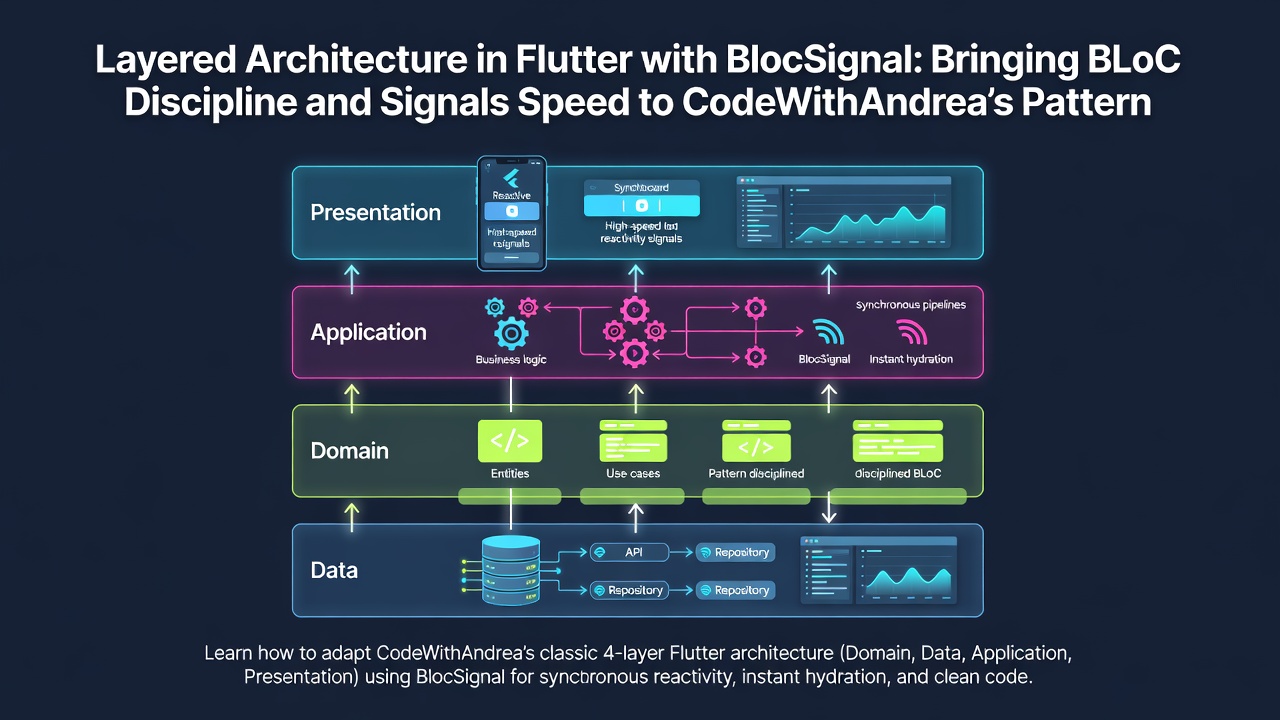
🏗️ The 4-Layer Architecture Overview
In a clean layered architecture, dependencies point strictly inward toward the Domain layer, while data flows in a clean unidirectional loop:
┌─────────────────────────────────────────────────────────┐
│                   Presentation Layer                    │
│    (Widgets, Screens, CubitSignal / BlocSignal)        │
└────────────────────────────┬────────────────────────────┘
                             │
                             ▼
┌─────────────────────────────────────────────────────────┐
│                    Application Layer                    │
│      (Service Classes, Derived computed() Signals)      │
└────────────────────────────┬────────────────────────────┘
                             │
                             ▼
┌─────────────────────────────────────────────────────────┐
│                       Data Layer                        │
│   (Repositories, Data Sources, Hydrated Storage)        │
└────────────────────────────┬────────────────────────────┘
                             │
                             ▼
┌─────────────────────────────────────────────────────────┐
│                      Domain Layer                       │
│    (Entities, Value Objects, AsyncState<T>, Rules)      │
└────────────────────────────┴────────────────────────────┘
Enter fullscreen mode Exit fullscreen mode
Each layer has a single, well-defined responsibility:
-
Domain Layer: Pure Dart entities, immutable models, and asynchronous state representations (
AsyncState<T>). -
Data Layer: Repositories, API data sources, and local persistent caching (
bloc_signals_hydrate). -
Application Layer: Service classes coordinating multi-repository transactions and reactive
computed()/futureSignal()business logic. -
Presentation Layer: State controllers (
CubitSignal/BlocSignal) and fine-grained Flutter UI widgets (BlocSignalBuilder,signal.watch(),context.select()).
Let's examine how to build each layer with BlocSignal.
1. The Domain Layer: Pure Entities & Async State
The Domain Layer contains the core business models and data structures of your application. It must remain 100% pure Dart—free from Flutter UI dependencies, HTTP clients, or database drivers.
Modeling Domain Entities
In BlocSignal, state containers automatically de-duplicate emissions when newState == oldState. By implementing proper equality contracts (using standard Dart ==, equatable, or freezed), downstream UI rebuilds and reactive computations are automatically skipped in O(1) time whenever data doesn't change.
// domain/cart_item.dart
import 'package:meta/meta.dart';

@immutable
class CartItem {
  const CartItem({
    required this.id,
    required this.name,
    required this.price,
    required this.quantity,
  });

  final String id;
  final String name;
  final double price;
  final int quantity;

  double get total => price * quantity;

  CartItem copyWith({int? quantity}) {
    return CartItem(
      id: id,
      name: name,
      price: price,
      quantity: quantity ?? this.quantity,
    );
  }

  @override
  bool operator ==(Object other) =>
      identical(this, other) ||
      other is CartItem &&
          runtimeType == other.runtimeType &&
          id == other.id &&
          quantity == other.quantity;

  @override
  int get hashCode => Object.hash(id, quantity);
}
Enter fullscreen mode Exit fullscreen mode
Representing Asynchronous State (AsyncState<T>)
When operations involve network requests or database reads, state models need to represent loading, data, and error states cleanly.
BlocSignal provides AsyncState<T> (with sealed variants AsyncData, AsyncLoading, and AsyncError), making async state modeling intuitive for UI layers:
// domain/user_profile.dart
import 'package:bloc_signals/bloc_signals.dart';

typedef UserProfileState = AsyncState<UserProfile>;

class UserProfile {
  const UserProfile({
    required this.id,
    required this.email,
    required this.name,
  });

  final String id;
  final String email;
  final String name;
}
Enter fullscreen mode Exit fullscreen mode
2. The Data Layer: Repositories & Instant Hydration
The Data Layer is responsible for fetching, storing, and persisting data from external sources (REST APIs, GraphQL, Firebase, SQLite).
Repositories
Repositories hide network or database complexities behind clean interfaces:
// data/auth_repository.dart
import '../domain/user_profile.dart';

abstract class AuthRepository {
  Future<UserProfile> fetchCurrentUser();
  Future<void> signOut();
}

class ApiAuthRepository implements AuthRepository {
  @override
  Future<UserProfile> fetchCurrentUser() async {
    // Simulated REST API fetch
    await Future<void>.delayed(const Duration(milliseconds: 500));
    return const UserProfile(
      id: 'usr_101',
      email: '[email protected]',
      name: 'Alex Developer',
    );
  }

  @override
  Future<void> signOut() async {
    await Future<void>.delayed(const Duration(milliseconds: 200));
  }
}
Enter fullscreen mode Exit fullscreen mode
Offline Caching & Frame 1 Hydration (bloc_signals_hydrate)
Standard stream-based state containers often suffer from "initial startup flicker" because state restoration runs asynchronously after the first UI render pass.
With bloc_signals_hydrate, HydratedCubitSignal hydrates state synchronously during object construction. Your cached offline data renders on frame 1 without loading spinners or layout jumps:
// data/user_session_cubit.dart
import 'package:bloc_signals_hydrate/bloc_signals_hydrate.dart';
import '../domain/user_profile.dart';
import 'auth_repository.dart';

class UserSessionCubit extends HydratedCubitSignal<UserProfileState> {
  UserSessionCubit(this._authRepository) : super(const AsyncLoading());

  final AuthRepository _authRepository;

  Future<void> loadUser() async {
    emit(const AsyncLoading());
    try {
      final user = await _authRepository.fetchCurrentUser();
      emit(AsyncData(user));
    } catch (error, stackTrace) {
      emit(AsyncError(error, stackTrace));
    }
  }

  @override
  UserProfileState? fromJson(dynamic json) {
    if (json is Map<String, dynamic>) {
      return AsyncData(UserProfile(
        id: json['id'] as String,
        email: json['email'] as String,
        name: json['name'] as String,
      ));
    }
    return null;
  }

  @override
  dynamic toJson(UserProfileState state) {
    if (state is AsyncData<UserProfile>) {
      final user = state.value;
      return {'id': user.id, 'email': user.email, 'name': user.name};
    }
    return null;
  }
}
Enter fullscreen mode Exit fullscreen mode
3. The Application Layer: Services, computed(), & futureSignal()
The Application Layer (Service Layer) coordinates multi-repository transactions and encapsulates cross-cutting business rules.
Eliminating Manual Callback Spaghetti with computed()
In traditional architectures, service classes require manual listener subscriptions, stream transformers, or manual disposal teardowns to keep multi-repository states in sync.
In BlocSignal, services leverage fine-grained computed() signals. Derived values calculate lazily and update automatically with zero manual listener management.
The futureSignal() Paradigm: Goodbye Try/Catch Boilerplate!
While traditional BLoCs rely on imperative try / catch / emit(AsyncLoading()) / emit(AsyncData()) boilerplate, BlocSignal supports futureSignal().
futureSignal(() => ...) wraps any asynchronous Future factory into a reactive signal. It automatically manages the entire lifecycle—instantly transitioning from AsyncLoading() to AsyncData() or AsyncError() without writing a single line of try/catch code!
// application/checkout_service.dart
import 'package:bloc_signals/bloc_signals.dart';
import '../domain/cart_item.dart';
import '../domain/user_profile.dart';
import '../data/user_session_cubit.dart';

class CheckoutService {
  CheckoutService({
    required this.cartItemsSignal,
    required this.userSessionCubit,
  }) {
    // 1. Declarative computed signals across multiple layers
    subtotalSignal = computed(() {
      final items = cartItemsSignal.value;
      return items.fold<double>(0, (sum, item) => sum + item.total);
    });

    taxSignal = computed(() {
      // 8% tax applied to subtotal
      return subtotalSignal.value * 0.08;
    });

    grandTotalSignal = computed(() {
      return subtotalSignal.value + taxSignal.value;
    });

    isEligibleForCheckoutSignal = computed(() {
      final hasItems = cartItemsSignal.value.isNotEmpty;
      final isAuthenticated = userSessionCubit.stateValue is AsyncData<UserProfile>;
      return hasItems && isAuthenticated;
    });
  }

  final ReadonlySignal<List<CartItem>> cartItemsSignal;
  final UserSessionCubit userSessionCubit;

  late final ReadonlySignal<double> subtotalSignal;
  late final ReadonlySignal<double> taxSignal;
  late final ReadonlySignal<double> grandTotalSignal;
  late final ReadonlySignal<bool> isEligibleForCheckoutSignal;

  // 2. Reactive FutureSignal: Automatically emits AsyncLoading -> AsyncData / AsyncError!
  // No imperative try/catch or manual emit() boilerplate required.
  late final userProfileSignal = futureSignal(() => userSessionCubit.loadUser());

  void refreshUser() => userProfileSignal.refresh();
}
Enter fullscreen mode Exit fullscreen mode
💡 Why is no
dispose()method needed?
In classic Rx streams orValueNotifier, calling.listen()or.addListener()inside a service creates permanent subscription links that leak memory unless manually cancelled via adispose()method.Signals work differently: a
computed()signal is lazy and self-tearing-down. It only subscribes to its upstream dependencies (cartItemsSignal,userSessionCubit.state) while downstream UI widgets are actively watching it. The moment widgets unmount and subscriber counts hit zero,computed()automatically detaches its listeners from upstream sources. Nodispose(), noStreamSubscription.cancel(), and zero memory leaks.
4. The Presentation Layer: Controllers & Surgical UI Rebuilds
The Presentation Layer consists of state controllers (CubitSignal or BlocSignal) and Flutter UI widgets.
Choosing Between CubitSignal and BlocSignal
-
CubitSignal: Ideal for direct method-driven state updates (e.g.,cartCubit.addItem(...)). -
BlocSignal: Ideal for complex event-driven workflows requiring streamless event transformers (droppable(),sequential(),restartable(), or customMutexlocks).
// presentation/cart_cubit.dart
import 'package:bloc_signals/bloc_signals.dart';
import '../domain/cart_item.dart';

class CartCubit extends CubitSignal<List<CartItem>> {
  CartCubit() : super(const []);

  void addItem(CartItem item) {
    final existingIndex = stateValue.indexWhere((i) => i.id == item.id);
    if (existingIndex >= 0) {
      final updated = List<CartItem>.from(stateValue);
      final current = updated[existingIndex];
      updated[existingIndex] = current.copyWith(quantity: current.quantity + 1);
      emit(updated);
    } else {
      emit([...stateValue, item]);
    }
  }

  void removeItem(String id) {
    emit(stateValue.where((item) => item.id != id).toList());
  }
}
Enter fullscreen mode Exit fullscreen mode
Automatic Error Routing & Operational Resilience
In BlocSignal, asynchronous event handlers (FutureOr<void>) automatically capture operational runtime exceptions and route them to onError and active telemetry observers (such as OtelBlocSignalObserver or DevToolsBlocSignalObserver). Programmer faults fail fast, while business exceptions transition safely without crashing the UI.
Surgical UI Binding (signal.watch)
In Flutter widgets, BlocSignal integrates natively with package:bloc_signals_flutter. Any widget holding a reference to a service, Cubit, or signal (via constructor injection, GetIt, or Riverpod) can simply call signal.watch(context) to subscribe to surgical, fine-grained rebuilds:
// presentation/checkout_screen.dart
import 'package:flutter/material.dart';
import 'package:bloc_signals_flutter/bloc_signals_flutter.dart';
import '../application/checkout_service.dart';
import 'cart_cubit.dart';

class CheckoutSummaryWidget extends StatelessWidget {
  const CheckoutSummaryWidget({
    super.key,
    required this.cartCubit,
    required this.checkoutService,
  });

  final CartCubit cartCubit;
  final CheckoutService checkoutService;

  @override
  Widget build(BuildContext context) {
    // 1. Watch CartCubit state signal directly (no InheritedWidget lookup needed!)
    final cartItems = cartCubit.state.watch(context);
    final cartItemCount = cartItems.fold<int>(0, (sum, i) => sum + i.quantity);

    // 2. Watch computed signals from CheckoutService
    final grandTotal = checkoutService.grandTotalSignal.watch(context);
    final isEligible = checkoutService.isEligibleForCheckoutSignal.watch(context);

    return Column(
      children: [
        Text(
          'Total ($cartItemCount items): \$${grandTotal.toStringAsFixed(2)}',
          style: Theme.of(context).textTheme.headlineMedium,
        ),
        const SizedBox(height: 16),
        ElevatedButton(
          onPressed: isEligible ? () => _processOrder(context) : null,
          child: const Text('Complete Purchase'),
        ),
      ],
    );
  }

  void _processOrder(BuildContext context) {
    ScaffoldMessenger.of(context).showSnackBar(
      const SnackBar(content: Text('Order placed successfully!')),
    );
  }
}
Enter fullscreen mode Exit fullscreen mode
💡 Dependency Injection Freedom: Why
BlocSignalProvideris Optional
In classic BLoC orpackage:provider, widgets must look up state containers from theBuildContexttree usingInheritedWidget(BlocProvider.of(context)).In
BlocSignal, because signals manage their own fine-grained subscriptions internally, any widget holding a reference to a signal or service (via constructor injection,GetIt, or Riverpod) can simply callsignal.watch(context). You are free to use constructor passing, service locators, orBlocSignalProvider—the framework never forces a rigid UI tree setup on you.
5. Testing Each Layer Deterministically
One of the greatest benefits of synchronous signal propagation is deterministic unit testing.
In stream-based BLoCs, testing asynchronous microtask queues requires await pump() or delayed stream draining. In BlocSignal, state propagation is synchronous. Combined with package:bloc_signals_test, unit testing across all 4 layers executes instantly without non-deterministic timing flakiness:
// test/application/checkout_service_test.dart
import 'package:bloc_signals_test/bloc_signals_test.dart';
import 'package:flutter_test/flutter_test.dart';
import 'package:bloc_signals/bloc_signals.dart';
import '../../data/user_session_cubit.dart';
import '../../domain/cart_item.dart';
import '../../application/checkout_service.dart';

void main() {
  group('CheckoutService Layer Integration Tests', () {
    late CartCubit cartCubit;
    late UserSessionCubit userSessionCubit;
    late CheckoutService checkoutService;

    setUp(() {
      cartCubit = CartCubit();
      userSessionCubit = UserSessionCubit(MockAuthRepository());
      checkoutService = CheckoutService(
        cartItemsSignal: cartCubit.state,
        userSessionCubit: userSessionCubit,
      );
    });

    tearDown(() async {
      await cartCubit.close();
      await userSessionCubit.close();
    });

    test('calculates subtotal, tax, and grand total synchronously on item addition', () {
      expect(checkoutService.subtotalSignal.value, equals(0.0));

      cartCubit.addItem(const CartItem(
        id: 'p1',
        name: 'Dart T-Shirt',
        price: 20.0,
        quantity: 2,
      ));

      // Synchronous assertions—no await pump() required!
      expect(checkoutService.subtotalSignal.value, equals(40.0));
      expect(checkoutService.taxSignal.value, equals(3.20));
      expect(checkoutService.grandTotalSignal.value, equals(43.20));
    });
  });
}
Enter fullscreen mode Exit fullscreen mode
🎯 Summary & Key Takeaways
Adapting Andrea Bizzotto’s 4-Layer Architecture to BlocSignal gives you the best of both worlds:
-
Domain Layer: Clean, pure Dart models with
O(1)equality de-duplication and expressiveAsyncState<T>modeling. -
Data Layer: Instant Frame 1 offline hydration via
bloc_signals_hydratewith zero startup flicker. -
Application Layer: Declarative, leak-free business logic using
computed()andfutureSignal()across multiple repositories with zero try/catch or teardown boilerplate. -
Presentation Layer: BLoC event discipline with fine-grained UI rebuilds via
signal.watch()—with zeroBlocSignalProviderorBuildContextrequirements! -
Testing: Instant, 100% deterministic unit testing with
bloc_signals_test.
Links & Resources
- 📖 Read Andrea Bizzotto’s original reference: CodeWithAndrea — Flutter App Architecture
- 📦 Package on Pub.dev:
bloc_signals - 🐙 GitHub Repository:
RandalSchwartz/BlocSignal
0 Comments
Log in to join the conversation.No comments yet. Be the first to share your thoughts.