
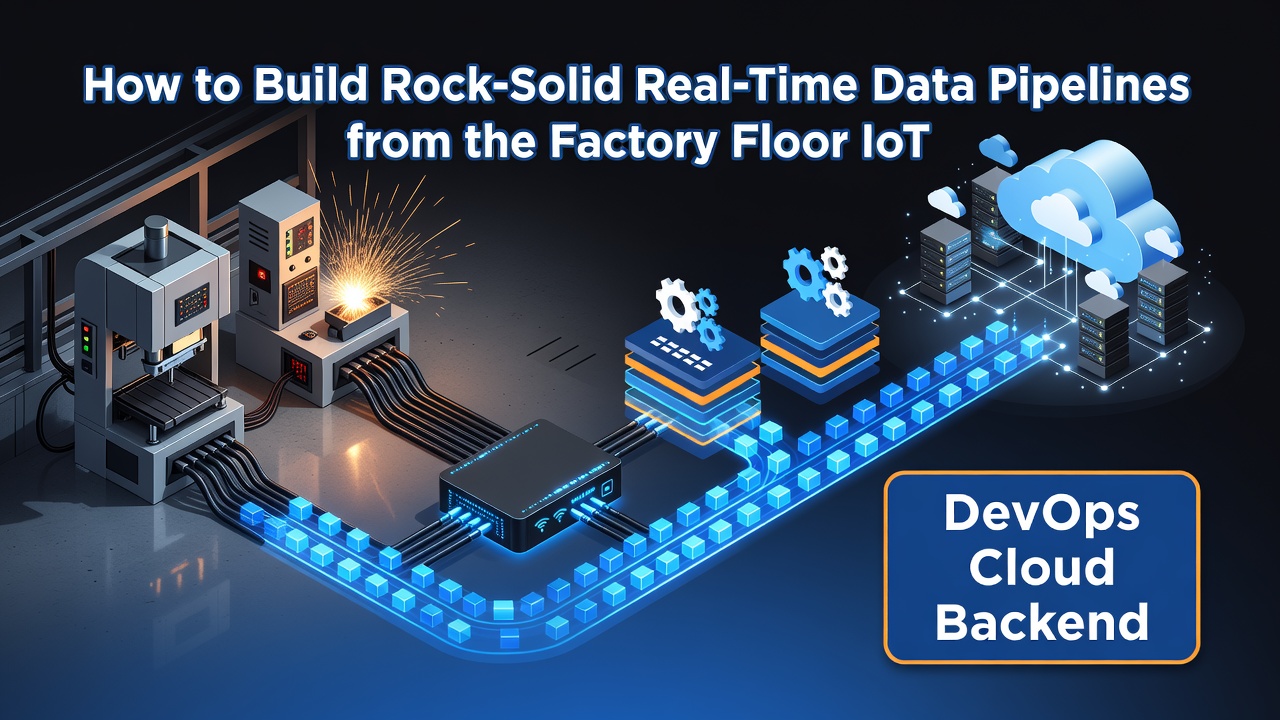

Lessons from hooking up stamping presses, welding cells, and MES without dropping a single byte of data.
If you’ve ever been tasked with trying to feed live sensor data from industrial gear into a modern app architecture, you’ve no doubt learned quickly that the shop floor is not exactly a cloud-native paradise. Automotive component manufacturing, in particular, is where we often get our toughest, most revealing stress tests. Think about it: there’s metal in abundance, wreaking havoc on our wireless signals; machinery hums 24/7, brooking zero downtime; and just one slipped event (like a WIP scan, a worker’s badge swipe, or a machine fault) can break the entire traceability chain, and only get noticed too late.
Here’s what truly matters in architecting a factory data layer.
MQTT for the Noisy Middle Layer
MQTT isn’t the default for industrial IoT for nothing - it's light, robust against shaky connections, and its pub-sub architecture aligns naturally with the many independent units spewing events on a floor (think stampers completing cycles, RFID readers snagging racks, BLE beacons logging worker badgetoes). Where teams often falter is with their QoS configurations. While QoS 0 is perfectly adequate for high-frequency stuff like vibration measurements where a dropped packet can be considered an unfortunate rounding error, you need QoS 1 or 2 for tracing operations - anything part of a genealogy record you can't afford to be incomplete.
Make sure you’re backing it all up with robust broker persistence.
A lost WIP status can wreck the history for an entire lot.
OPC UA for Structured Machine Data
If MQTT serves as the plumbing, then OPC UA is generally the language spoken by devices interacting directly with PLCs, CNCs, and SCADA systems. Instead of a jumbled byte stream, you get a structured information model, which is absolutely critical when you're stitching together machines from different manufacturers on the same production line. Of course, OPC UA isn’t without its own complexities - setting up OPC UA servers and address spaces takes time and effort, and it can easily be overkill for simple data streams. A pragmatic approach involves using OPC UA for machine-level communication, and then normalizing things through MQTT or a message queue from there.
Edge Processing Isn't an Option
A vast majority of factory floor architectures flounder simply because they assume a constant, near-instantaneous connection to a cloud data lake. This fantasy evaporates quickly in a facility filled with metal barriers, welding interference, and segmented networks implemented for security. Pushing inference and filtering to the edge - from simple debouncing of duplicated RF ID scans to threshold alerts on sensor readings-can drastically slash the required bandwidth while minimizing network noise. Crucially, it ensures the plant floor can keep chugging along even if the internet connection flakes out.
Design for Genealogy, Not Just Telemetry
This one is crucial to understand if you’re coming into manufacturing IoT from a general data background; telemetry and genealogy are distinctly different animals. Telemetry can afford some sampling and occasional loss; but genealogy, detailing the lineage of a product from its lot to specific shift and machine, needs to be treated more like a transactional journal entry. This typically requires the synchronous write of these events to a reliable datastore, even if your overall telemetry stream is designed with eventual consistency.
If you're plumbing this sort of pipeline for the first time, Compentra AI has a handy overview outlining how RFID/BLE/UWB ingestion, MQTT/OPC UA connectivity, and MES/SCADA system integrations interoperate specifically within the Automotive space. Check it out if you’d prefer a reference architecture rather than figuring it all out in your head.
The True Takeaway
None of these underlying technologies is inherently magical. The trick to getting it right lies in ordering their operations - edge filtering before transmission, rich semantic models at the machine interface, durable storage for critical trace records, and eventually consistent processing where you can afford to lose a bit of fidelity. Mess up the sequence, and you can end up with a system that appears to offer real-time information on a screen, but fails to provide a concrete answer to “what lot does this component come from?” when the heat is on.
0 Comments
Log in to join the conversation.No comments yet. Be the first to share your thoughts.