
[Submitted on 24 Jul 2026]
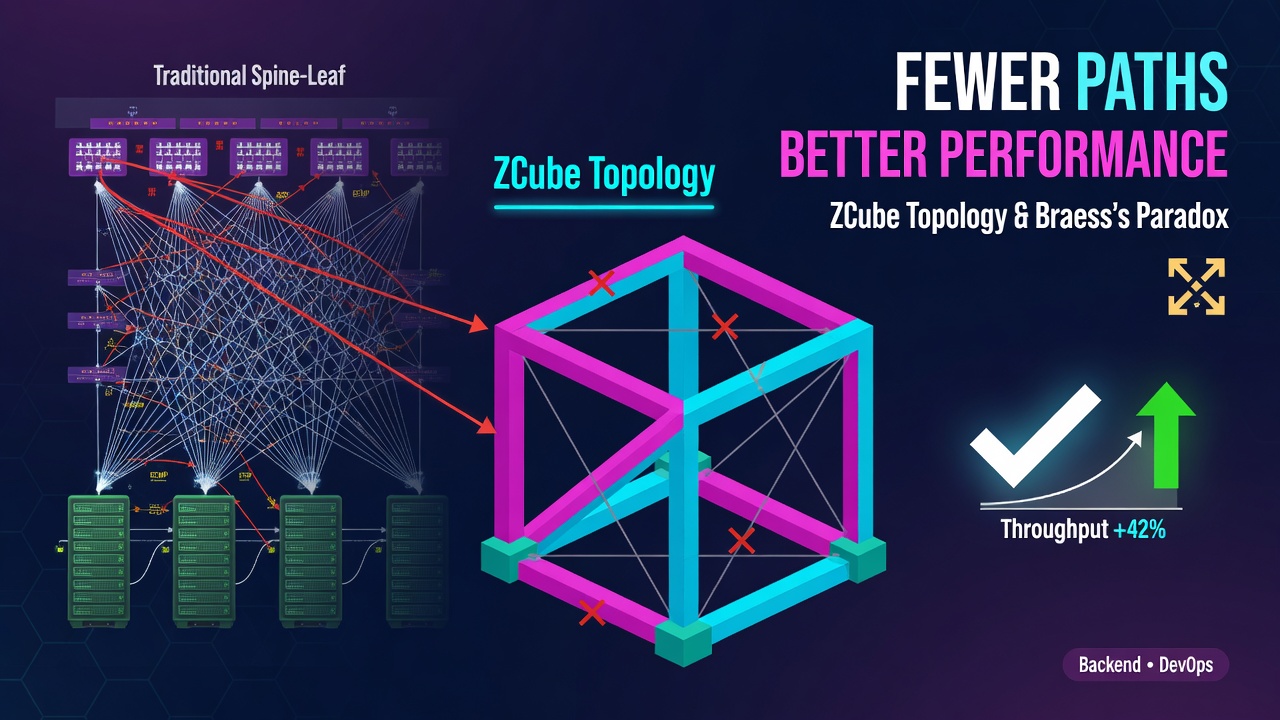
Abstract:Datacenter networks follow a multipath doctrine: provision many paths between endpoints, hash flows across them, and let redundancy absorb both failures and load imbalance. The ZCube topology violates this doctrine. It removes the Spine layer, eliminates path multiplicity, and cuts one third of switching hardware, yet delivers better performance for both large model training and inference. We explain this anomaly through a structural connection to Braess's paradox, first observed in 1968: both phenomena trace to congestion-oblivious routing over competing paths. Braess showed that adding paths under this condition can hurt; ZCube shows that removing paths under the same condition can help. First, we show that multipath fabrics under structured LLM traffic operate in Braess's shadow: static ECMP hashing is strictly more fragile than greedy routing. Greedy routing reaches an equilibrium within 4/3 of optimal for affine latencies; static hashing admits unbounded imbalance in the worst case. Second, we prove that ZCube is immune to Braess's paradox and that its orthogonal dual partition provably balances load for arbitrary traffic matrices; AllReduce in training and KV cache transfers in disaggregated inference fall out as two corollaries. Third, we quantify the price of this immunity: ZCube trades microsecond hash recovery for millisecond control plane recovery, a trade that upper-layer resilience in LLM serving makes favorable. Production measurements from a cluster serving GLM-5.1 coding inference report 33% lower network cost, 15% higher GPU throughput, and 40.6% lower P99 time to first token. Our analysis suggests that for workloads driven by model structure, matching topology to traffic matters more than path multiplicity.
Submission history
From: Li Chen [view email]
[v1]
Fri, 24 Jul 2026 01:46:44 UTC (35 KB)
0 Comments
Log in to join the conversation.No comments yet. Be the first to share your thoughts.