
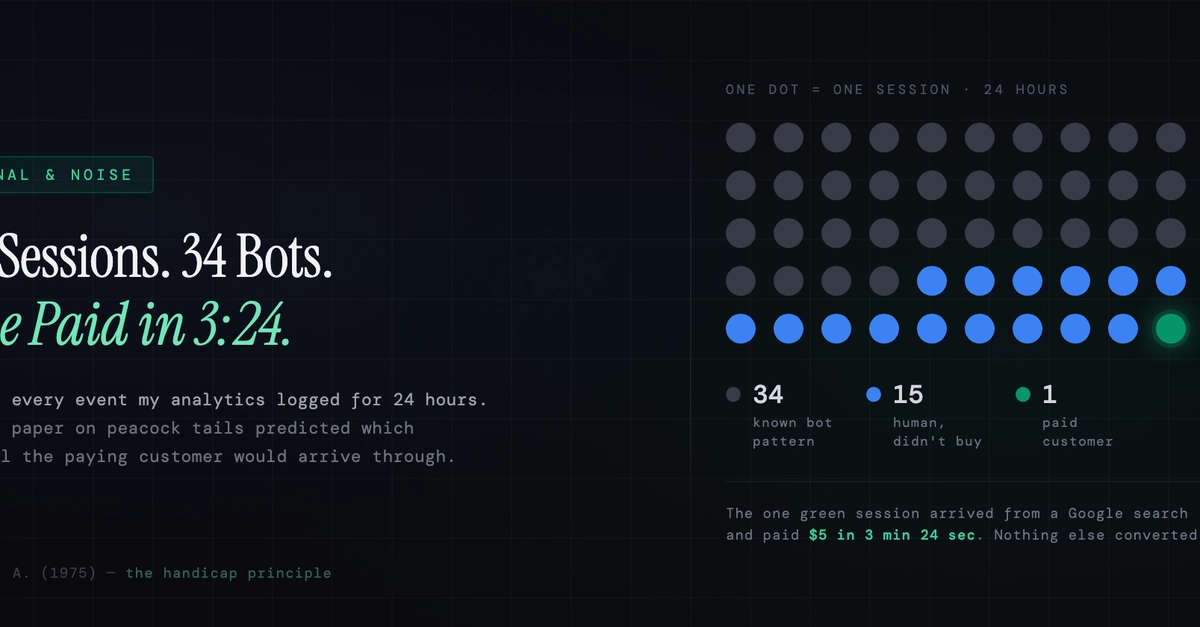
Yesterday I pulled every single event my analytics recorded for one full day and read it line by line. Not a dashboard summary — the raw per-user event stream for all 50 sessions.
Here's what a day of "traffic" actually looks like for a small SaaS:
| Sessions recorded | 50 |
| Traceable to a known bot pattern | 34 |
| Plausibly human | 16 (one of which was me) |
| Signed up | 5 |
| Paid | 1 |
The interesting part isn't the ratio. It's which of those 16 humans paid, and how fast. Because a peacock's tail predicted it.
The customer: 3 minutes and 24 seconds
One visitor found a blog post of mine through a Google search. Here is their entire session, timestamped from the moment they landed:
| Elapsed | What happened |
|---|---|
| 0:00 | Landed on a technical blog post from Google organic search |
| 0:22 | Clicked through to the login page |
| 0:37 | Signed up with GitHub OAuth |
| 1:00 | Pasted a repo URL, validation passed |
| 1:45 | Opened checkout |
| 3:24 | Paid $5 |
| 4:20 | Started generating a video |
| 14:04 | Video finished |
| 14:16 | Shared it to Hacker News, then watched it start to finish |
First visit. No prior session. No retargeting. No email nurture sequence. They read something I wrote, decided I was credible, and were a paying customer before the kettle boiled.
The other 34: a masterclass in cheap signals
Meanwhile, here's what else arrived that day.
Eleven sessions from Singapore. Windows and Linux, Chrome, each one hitting exactly one blog post, each producing exactly four events — first_visit, session_start, page_view, scroll — with 0.0 seconds of engagement time. Same fingerprint, eleven times.
Six sessions from Ashburn, Virginia — which is to say, from AWS us-east-1. Four of them arrived inside a two-minute window, each claiming a different referrer: everystockphoto.com, findly.tools, zhongsou.com, deeperweb.com. Four different "sources", one datacenter, 120 seconds.
Four sessions from Sapporo, Japan. Linux, Chrome, landing on the homepage at 01:02, 07:21, 14:47, and 21:27 — roughly every six to seven hours, like a cron job. Each reported 1.3–1.4 seconds of engagement, which is what a bot looks like when it has learned that zero engagement gets it filtered.
Four sessions with no geography at all. No country, no city, no OS. Three fired simultaneously at 15:54, walking different blog URLs.
Every one of those referrers is technically a backlink. Every one of them shows up in a traffic report as a "referral channel". Not one of them was a person.
The theory: cost is what makes a signal honest
In 1975, the biologist Amotz Zahavi published the handicap principle in the Journal of Theoretical Biology. The puzzle he was solving: why do peacocks grow tails that make them slower and more visible to predators? His answer was that the handicap is the message. Any peacock can be born; only a genuinely fit one can afford to drag that thing around and survive. The cost is what makes the claim impossible to fake.
Two years earlier and in a completely different field, Michael Spence published "Job Market Signaling" in the Quarterly Journal of Economics — the work that later won him a Nobel. Same structure: an employer can't observe your ability, but a degree is cheaper to obtain if you're capable, so the cost of acquiring it separates the capable from the rest.
The idea reached marketing quickly. Phillip Nelson argued in 1974 that advertising works as information even when the ad says nothing. Paul Milgrom and John Roberts formalized it in the Journal of Political Economy (1986, 94(4), 796–821): introductory price and deliberately uninformative advertising spend can both function as credible quality signals, because only a firm expecting repeat purchases can afford to burn the money. Amna Kirmani and Akshay Rao gave the field its canonical review in the Journal of Marketing — "No Pain, No Gain" (2000, 64(2), 66–79), which is still the map of this territory. Brian Connelly and colleagues broadened it across management research in 2011.
The title of that Kirmani and Rao paper is the whole thesis. No pain, no gain. A signal that costs nothing to send carries no information, because anyone can send it. Economists call the worthless kind cheap talk.
Scoring my own channels by cost-to-fake
Once you have that lens, "which marketing channel should I invest in" stops being about traffic volume and becomes a single question: how hard is this signal to counterfeit?
| Signal | Cost to produce | Cost to fake | What it got me |
|---|---|---|---|
| Auto-submission to AI tool directories | ~2 min form | ~2 min form | Bot traffic, spam referrers, zero revenue |
| Referral "backlinks" from aggregator sites | $0 | $0 | 6 datacenter sessions in 2 minutes |
| Paid newsletter placement | Money only | Money only | Real humans, 1 signup, no purchase |
| A technical article that earns a search ranking | Weeks of writing + indexing | Weeks of writing + indexing | A customer in 3 minutes 24 seconds |
The directory listings aren't fraudulent — they're just cheap talk. Getting listed proves nothing about my product, because getting listed requires nothing. So the market correctly ignores them, and the only entities that traverse those links are crawlers.
The blog post is expensive in exactly the way Zahavi meant. To rank for a query a developer actually types, I had to write something a developer actually wanted, and then wait weeks while Google decided whether to believe me. I can't shortcut that with a form submission. Which is precisely why someone who arrives through it is willing to hand me money 204 seconds later.
This also explains something that had been bothering me: links from dev.to, Medium, and Hashnode are nofollow ugc and — as I've measured on my own rankings — don't move search position at all. Of course they don't. Anyone can post anywhere. The platforms know it, so they mark every outbound link as unvouched. Cheap talk, formalized in an HTML attribute.
The uncomfortable part
I build RepoClip, which generates promotional videos from GitHub repositories. Writing this article forced me to notice what my product actually is.
The video's informational content is modest — it's a minute of narrated visuals about a codebase. But that was never the point. A demo video is a costly signal attached to a repository. It says: someone cared enough about this project to produce one. Anyone can write a README. Not everyone bothers with a video. That gap is the entire message, and it's the same gap as the peacock's tail.
Which reframes my own pricing. The free tier watermarks the output; paying removes it. I used to describe that as a feature difference. It isn't. Paying to remove the watermark is the customer buying a costly signal for their own project — spending money so that the people evaluating their repo can see they spent money. My pricing page has been selling a resolution bump when it should have been selling credibility.
And note what my 3-minute customer did at 14:16, immediately after the video finished: they posted it to Hacker News. They didn't buy a video file. They bought something to show people.
What I'm changing
- Stop counting directory listings as distribution. They're a bot magnet. I'll keep the ones that require actual editorial review and drop the rest from the plan.
- Treat blog posts as the primary channel, not the content-marketing side quest. One post produced one customer in one day. Nothing else did.
- Rewrite the paid-tier copy around signaling instead of specs. Not "1080p, no watermark" — "show people you meant it."
- Fix my bot filter. My standard exclusion rule was "zero engagement and three events or fewer." The Singapore cluster sends four events. The Sapporo cluster reports 1.4 seconds. I was under-counting bots by roughly 3x, which means every conversion rate I've calculated for months has been quietly wrong in my favor.
That last one is the real lesson of reading raw event logs instead of dashboards. Half of what I thought was an audience was infrastructure talking to itself.
References
- Zahavi, A. (1975). Mate selection — a selection for a handicap. Journal of Theoretical Biology, 53(1), 205–214.
- Spence, M. (1973). Job Market Signaling. Quarterly Journal of Economics, 87(3), 355–374.
- Nelson, P. (1974). Advertising as Information. Journal of Political Economy, 82(4), 729–754.
- Milgrom, P., & Roberts, J. (1986). Price and Advertising Signals of Product Quality. Journal of Political Economy, 94(4), 796–821.
- Kirmani, A., & Rao, A. R. (2000). No Pain, No Gain: A Critical Review of the Literature on Signaling Unobservable Product Quality. Journal of Marketing, 64(2), 66–79.
- Connelly, B. L., Certo, S. T., Ireland, R. D., & Reutzel, C. R. (2011). Signaling Theory: A Review and Assessment. Journal of Management, 37(1), 39–67.
I run RepoClip, which turns GitHub repos into demo videos. If you've read your own raw event logs recently and found something similar, I'd like to hear about it.
0 Comments
Log in to join the conversation.No comments yet. Be the first to share your thoughts.