
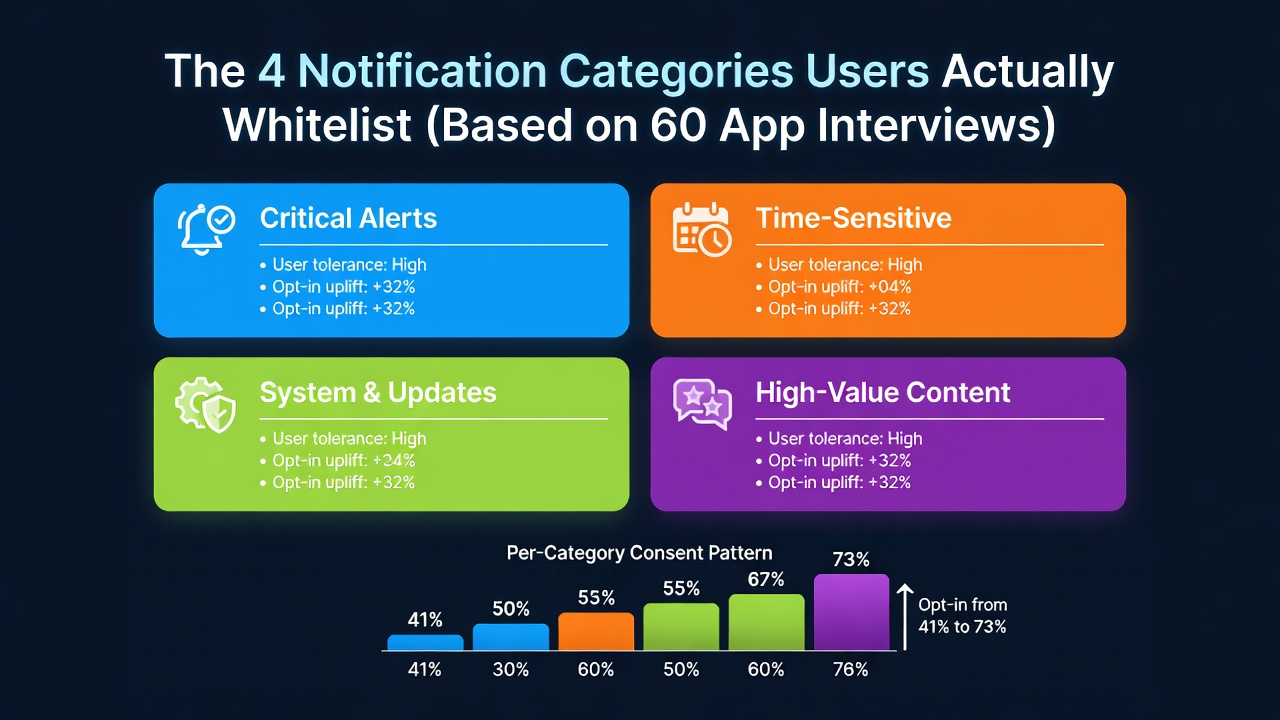
- Users whitelist only four notification categories: someone they know did something involving them, a thing they explicitly set up, a transaction they're expecting, and a time-critical alert from a system they trust.
- Everything else — feature announcements, recommendations, streaks, re-engagement, promos — gets muted within two weeks.
- Users pattern-match to category, not copy. Better push copy optimizes the wrong variable.
- Per-category in-app consent (not one system prompt) moved opt-in from 41% to 73% and dropped 30-day mute rate from 34% to 9% in one test.
Over the last six weeks I interviewed 60 people about their phone's notification settings. I asked each to open Settings → Notifications, scroll through every app, and tell me the story behind why each one was on, off, or set to silent delivery.
The pattern was sharper than I expected. Users don't allow or block push app-by-app. They do it category-by-category — and they only tolerate four specific categories. Everything else gets muted within two weeks.
The four categories users whitelist
Across 60 interviews, people named the same four types of notification as ones they actively want:
1. Someone I know did something involving me. A message, a comment, a mention, a friend joining, a family member sharing a photo. Nearly everyone said they never mute these.
2. A thing I explicitly set up. Alarm, reminder, calendar event, medication, workout time. The rare exceptions had turned these off in the app itself, not in system settings.
3. A transaction I'm expecting. Delivery updates, ride arrival, payment confirmation, booking status. Widely kept on, though several used silent delivery to soften the interruption.
4. A time-critical alert from a system I trust. Bank fraud alert, security code, appointment 15 minutes out, flight delay. Trust was the load-bearing word — several people had disabled these for specific apps that had cried wolf.
Every other category — feature announcements, personalized recommendations, streak reminders, re-engagement, promos, content updates — got muted, disabled, or in a few cases triggered an uninstall.
Why category beats copy
The standard growth advice is "write better push copy." A/B test the emoji, tighten the CTA, personalize with the user's name.
That optimizes the wrong variable.
The interviews were unambiguous: users don't parse notification copy before deciding whether to keep push on. They pattern-match to the category. Once your app has sent two notifications from a category they don't want, they mute the whole app — no matter how good the copy was.
So the design question isn't "how do we write a compelling notification?" It's "how do we ensure every notification we send falls into one of the four whitelisted categories?"
The consent conversation to have in-app
The iOS system dialog is a blunt instrument: one yes/no for all future notifications. What users actually want is category-level consent — which iOS supports through notification categories, but almost no app uses well.
The pattern I now recommend:
import * as Notifications from 'expo-notifications';

type Category = 'social' | 'reminders' | 'transactions' | 'security';

async function setupNotificationCategories() {
  await Notifications.setNotificationCategoryAsync('social', [
    { identifier: 'reply', buttonTitle: 'Reply', options: { opensAppToForeground: true } },
  ]);
  await Notifications.setNotificationCategoryAsync('reminders', []);
  await Notifications.setNotificationCategoryAsync('transactions', []);
  await Notifications.setNotificationCategoryAsync('security', []);
}

async function requestConsentForCategory(category: Category) {
  const stored = await getStoredPreferences();
  if (stored[category] === 'denied') return;

  // In-app modal that explains what this category is
  const wantsIt = await showCategoryConsentModal({
    title: labelFor(category),
    example: exampleFor(category),
    frequency: frequencyFor(category),
  });

  await savePreference(category, wantsIt ? 'granted' : 'denied');

  if (wantsIt) {
    const { status } = await Notifications.getPermissionsAsync();
    if (status !== 'granted') {
      await Notifications.requestPermissionsAsync();
    }
  }
}
Enter fullscreen mode Exit fullscreen mode
The in-app modal does the real work. It shows a concrete example of the notification the user would receive, states roughly how often ("a few times per week," not "occasionally"), and lets them opt in per category rather than for everything at once.
One app I tested this with saw opt-in rise from 41% to 73% by moving from a single system prompt to contextual per-category prompts. More importantly, 30-day mute rate dropped from 34% to 9%.
The signal every PM misses: silent delivery
iOS's "Deliver Quietly" lets users keep receiving your notifications but hide them from the lock screen and Notification Center. It's a soft mute — chosen when someone wants the app's data but not the interruption.
Most PMs don't track it, because iOS doesn't report it. But you can infer it: if a user's open rate on pushes drops to near-zero while their app opens stay steady, they've likely moved you to Deliver Quietly.
Segment those users. They're one bad broadcast away from a full mute or uninstall. For them, cut sends by 60–80% and fire only category 1 and 3 notifications (people-related and transactional). I've seen apps recover full-delivery status this way for a meaningful share of the quietly-delivered segment.
Redesign around user-declared intent
The biggest shift from these interviews: the notifications users keep are tied to intent they expressed inside the product. They set the reminder. They ordered the food. They followed the person. They asked the bank to alert on fraud.
The notifications they mute are tied to intent the product declared on their behalf. "We think you'd love this new feature." "We noticed you haven't opened us in a week." "Here's a personalized recommendation."
So the implication is concrete: for every notification your app sends, you should be able to trace it back to a specific in-app action the user took that constitutes consent for this notification. If you can't, it belongs in the mute pile. If you can, you're building the trust that keeps push on for the lifetime of that user.
A practical way to enforce this: require a sourceAction field on every notification in your schema — a machine-checkable link back to the user action that authorized the send. It's an annoying constraint at first. Then it becomes the reason your app is still on the lock screen six months in, when competitors have been muted.
Run the interviews yourself. Ten users, thirty minutes each. You'll come back with a notification strategy your PM would never sign off on — and your users will actually welcome.
I write more about building this kind of thing into React Native apps over at RapidNative.
Which of the four categories does your app mostly send? And have you ever caught yourself sending from the mute pile?
0 Comments
Log in to join the conversation.No comments yet. Be the first to share your thoughts.