
What to Expect
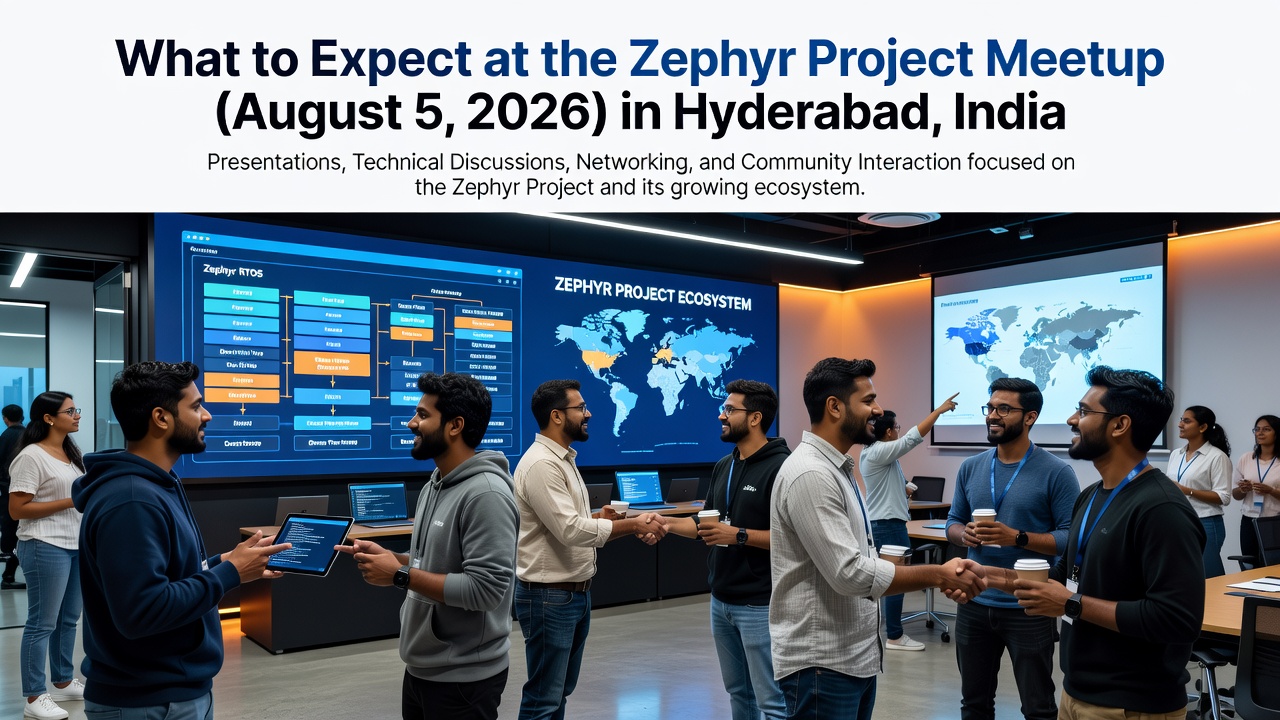
The Zephyr Project Meetup in Hyderabad will feature an evening of presentations, technical discussions, networking, and community interaction focused on the Zephyr Project and its growing ecosystem.
Sessions will explore products running Zephyr, subsystem developments, developer tools, security, connectivity, testing, hardware support, practical implementation experiences, and Zephyr features that developers may not have encountered before.
Attendees will also have opportunities to meet other members of the local embedded systems community, share their experiences, ask questions, and discover new ways to participate in the Zephyr Project.
Event Details
- Date: August 5, 2026
- Time: 5:00 PM–9:30 PM
- Location: Silicon Labs, Hyderabad, India
- Organized by: Dotstar Systems
- Venue host: Silicon Labs
Agenda
The meetup agenda will include technical talks from the host teams and members of the local Zephyr and embedded systems community.
5:00 pm – 5:15 pm: Welcome Snacks and Drinks
5:15 pm – 5:30 pm: Welcome Note – DotStar Systems and Silicon Labs teams
5:30 pm – 5:45 pm: BLE on Zephyr-Rust: Bringing bt-hci to Zephyr over HCI-RAW – Ramana Gudipudi, Software Engineer – Bluetooth, Silicon Labs
Zephyr provides a mature Bluetooth controller and HCI infrastructure, while Rust BLE hosts such as trouble-hosts offer a Rust-native host model. This talk proposes an optional bt-hci transport for Zephyr over HCI RAW, enabling Rust BLE hosts to run on Zephyr without replacing Zephyr’s native Bluetooth stack or board-specific HCI drivers.
We will explain the transport architecture, H:4 packet handling, buffer ownership, and the boundary between Zephyr and Rust. The talk will include a working Rust BLE peripheral running on a Silicon Labs EFR32MG24 board, demonstrating controller communication, advertising, connection handling, and a basic GATT service.
The implementation begins with a blocking transport and we will discuss a path toward asynchronous operation, trouble-host integration, and broader Zephyr controller support.
5:50 pm – 6:20 pm: Why Wi-Fi Can’t Go Fully PSA — A Field Report from the Mbed TLS 4.x Migration in Zephyr – Chaitanya Tata, Founder, DotStar Systems
Mbed TLS 4.x and TF-PSA-Crypto 1.0 make the PSA Crypto API the mandated interface for cryptography in Zephyr and nRF Connect SDK — and that migration forced a reckoning for Wi-Fi security. This is a field report from porting Wi-Fi crypto (WPA3-SAE, Enterprise/EAP, WPS, DPP) onto the new stack for nRF Connect SDK 3.4.0 LTS.
We will trace a short history of Wi-Fi crypto in Zephyr, then dig into what actually changed in 4.x: primitives that disappeared, keys that moved, and why Wi-Fi hits a “”legacy floor”” — standards-mandated algorithms (WPS DH/SHA-1, EAP-MD5, MSCHAPv2) that PSA will never accept. We will look at how WPA3-SAE PWE derivation was brought into PSA by extending the PAKE interface (the Arm PSA Crypto spec effort), and close on the open frontier: opaque keys, and what it would take to split hostap/wpa_supplicant across a secure/non-secure boundary.
Presented from hands-on experience owning the Wi-Fi-crypto parts of this migration, in a personal capacity. Takeaways for anyone shipping Wi-Fi, TLS, or PSA-based crypto on constrained devices.
6:25 pm – 6:40 pm: One Timeout Queue, Four Backends – Sayooj K. Karun, Senior Staff Engineer, Aerlync Labs Inc.
The presentation talks about the recently introduced experimental timeout subsystem back-ends. (CONFIG_TIMEOUT_BACKEND_BUCKET, CONFIG_TIMEOUT_BACKEND_MINHEAP, CONFIG_TIMEOUT_BACKEND_WHEEL, and default DLIST backend) https://github.com/zephyrproject-rtos/zephyr/pull/111746
6:45 pm – 7:15 pm: ELD: Rethinking Link-Time Behavior for Embedded Systems at Scale – Parth Arora, Senior Engineer, Qualcomm
Qualcomm open-sourced ELD (Embedded Linker Driver) approximately a year ago, making available a production-grade linker that has been developed and deployed extensively within Qualcomm’s LLVM toolchain. ELD was purpose-built to address the demanding requirements of embedded systems development—requirements that are often not fully met by traditional general-purpose linkers.
While established linkers perform well for desktop and server-class platforms, embedded environments introduce a different set of constraints, including strict memory budgets, highly customized memory layouts, tight performance expectations, and the need for deep visibility into the linking process. ELD is designed from the ground up to meet these needs, enabling both efficiency at scale and precise developer control.
Within Qualcomm, ELD serves as the default linker for building firmware and software images across a wide range of platforms, reflecting its maturity and robustness in large-scale production environments. It is tightly integrated with the LLVM toolchain and supports multiple architectures—including Hexagon, ARM, AArch64, and RISC-V—with a modular design that enables straightforward extensibility to additional or custom targets.
ELD’s design emphasizes both performance and usability, offering:
– A fast and resource-efficient linker core with strong GNU compatibility, enabling seamless adoption in existing build systems
– Advanced diagnostics and highly detailed map files, providing actionable insights into memory layout, symbol placement, and linker decisions
– A flexible plugin framework, enabling custom analyses, reporting, and domain-specific extensions to the linking process
– A modular and scalable architecture, simplifying support for new targets and evolving embedded requirements.
– Comprehensive, developer-focused documentation, including detailed guides and an actively maintained FAQ to support onboarding, troubleshooting, and advanced workflows.
Beyond core functionality, ELD places strong emphasis on developer productivity and debuggability. Its rich diagnostic capabilities—such as enhanced reporting, traceability of linker decisions, and improved map file generation—enable faster root-cause analysis and more predictable builds, which are critical in complex embedded environments.
As part of ongoing efforts to strengthen robustness and ecosystem integration, we are actively working to build and test Zephyr RTOS using ELD together with LLVM. Zephyr has been adopted within Qualcomm, and its diverse embedded workloads provide a valuable platform for stress-testing linker behavior. This effort helps uncover edge cases, improve both Zephyr and linker stability, and ensure reliability across a broad spectrum of real-world use cases.
This talk will explore the motivations and design principles behind ELD, including lessons learned from deploying it at scale within Qualcomm. We will highlight its key capabilities, share real-world use cases where ELD has delivered measurable improvements in build performance and developer workflows, and discuss its evolution since being open-sourced. The session will also outline ongoing collaboration with the open-source community and the roadmap for future enhancements, particularly in areas such as extensibility, diagnostics, and broader ecosystem integration.
7:15 pm – 7:30 pm: Break and Networking
7:35 pm – 7:50 pm: High-Speed Storage: Landing UFS in Zephyr RTOS – Ajay Neeli, Member of Technical Staff, Advanced Micro Devices
Universal Flash Storage (UFS) is the high-throughput, low-latency storage interface powering modern smartphones, automotive systems, and increasingly demanding embedded applications—yet Zephyr had no native support for it. This talk walks through the design and upstreaming of a complete UFS storage stack for Zephyr (PR #93528).
I’ll walk through the layered architecture: a reusable SCSI subsystem for command transport, a UFS subsystem on top, an AMD Versal Gen 2 UFS Host Controller driver, and a UFS disk driver exposing storage to Zephyr’s disk-access API. I’ll explain the key design decisions, how the driver maps to Zephyr’s model, and how it plugs into existing storage abstractions.
7:55 pm – 8:10 pm: Modernizing Legacy Embedded Applications Using Zephyr RTOS: Lessons from Eaton’s Platform Transformation – Prayas Samriya, Embedded Software Architect, Eaton Corporation
Industrial embedded systems often outlive the software architectures they were originally built upon. As product portfolios grow, maintaining proprietary foundations becomes increasingly expensive and slows innovation.
In this session, Eaton shares its experience modernizing legacy embedded applications by transitioning from a FreeRTOS-based platform to a Zephyr RTOS-based architecture.
We discuss the technical challenges encountered during the journey, including abstraction layers, peripheral portability, middleware migration, bootloaders, communication protocols, testing strategies, and product adoption considerations.
Beyond the technical migration itself, we will share how adopting an open-source ecosystem influenced engineering practices, platform architecture, and long-term maintainability. We will also describe how Eaton is exploring AI-assisted engineering workflows to accelerate migration planning, identify architectural gaps, automate portions of version upgrades, and reduce engineering effort.
The session will conclude with key recommendations and lessons learned for teams planning similar transformations of legacy embedded products.
8:15 pm – 8:45 pm: Extending Zephyr’s Counter & RTC APIs: Adding Calibration for Real Hardware RTCs – Harini T., Senior Software Engineer, Advanced Micro Devices
Zephyr’s Counter and RTC subsystems are widely used, but until recently there was no standard way to expose the clock-drift calibration that many real-world RTC peripherals provide in hardware. This talk walks through the design and upstreaming of a new calibration API added to Zephyr’s Counter driver API, and the enhancements to the generic rtc_counter wrapper that let any counter-backed clock behave as a proper, always-on, calibratable RTC.
We’ll cover the API design decisions (get/set calibration, units, and error semantics), the syscall-handler plumbing that makes it safe from user mode, and — importantly — how the change stays fully backward-compatible so existing counter drivers keep working untouched. A Xilinx ZynqMP RTC serves only as the motivating example; the takeaways apply to any RTC/counter driver. Attendees will leave understanding how to identify a genuine subsystem gap, propose an API that satisfies maintainers, and land it upstream without breaking the ecosystem.
8:50 pm – 9:05 pm: RF Fingerprinting, Wi-Fi Security Using TinyML and Zephyr OS – Jaiganesh Narayanan, Systems and Solutions Architect, Aerlync Labs Inc.
A complete technical guide to passive 802.11 monitoring, TinyML device classification, security threat detection, and AI-assisted network analysis on Nordic Semiconductor hardware using ZephyrOS
9:10 pm – 9:25 pm: Crash Dumps Without Cables: Live Coredump Capture over UDP/Ethernet in Zephyr RTOS – Appana Durga Kedareswara Rao, MTS Software Engineer, AMD
When an embedded system crashes in the field, recovering the coredump often determines whether debugging takes hours or weeks. Zephyr has long supported coredumps over UART, but in modern industrial, IoT, and edge deployments the serial port is rarely accessible. Devices may be sealed in cabinets, deployed remotely, or connected only via network.
This talk introduces a new Zephyr coredump backend that streams crash data over UDP (IPv4/IPv6) at the moment of a fatal exception—no USB cable or physical access required. We will explore the design challenges of networking in the fatal path, including safely re-enabling interrupts so the NIC can transmit, and the ZCDU framing protocol used to packetize and reliably reassemble dumps from UDP datagrams. We also show how the host receiver integrates seamlessly with the existing Zephyr GDB workflow, making the switch from UART to Ethernet a simple Kconfig option. Attendees will learn how to enable fleet-scale crash capture and dramatically reduce time-to-root-cause for deployed Zephyr devices. pull request : https://github.com/zephyrproject-rtos/zephyr/pull/108410.
9:25 pm – 9:30 pm: Zephyr Quiz, Thank-You Note and Closing Remarks
Registration Is Closed
Registration for this meetup is now closed. Thank you to everyone who registered. The strong interest in this event reflects the growing Zephyr and embedded systems community in Hyderabad and across India.
If you were unable to register this time, please stay tuned. More Zephyr Project meetups are coming soon, and we look forward to welcoming you at a future event.
Registered attendees are encouraged to check their email for final event details and participation instructions from the organizers.
Thanks to Our Supporters
Thank you to Dotstar Systems for organizing the Zephyr Project Meetup in Hyderabad and supporting the growth of the local Zephyr and embedded systems community.
Thank you also to Silicon Labs for serving as the venue host and providing a space where developers, contributors, students, and technology professionals can come together to learn and connect.
A special thank you to Nordic Semiconductor for sponsoring the development board giveaways, food, and beverages for the meetup. Their support helps create a welcoming and interactive event experience for attendees while encouraging hands-on learning and community engagement.
Community support from local organizations, speakers, volunteers, sponsors, and attendees makes these gatherings possible and creates more opportunities for technical knowledge sharing and open source collaboration.
Board Giveaways and Food and Beverage Sponsorship
Development board giveaways, food, and refreshments help make Zephyr community meetups more interactive, welcoming, and valuable for attendees.
Organizations interested in sponsoring development boards, food, or beverages for an upcoming Zephyr Project Meetup can complete the sponsorship interest form. The meetup organizers will follow up with information about suitable events and coordination details.
About the Zephyr Community Meetups
This meetup is part of the Zephyr Community Meetup Series, a collection of local gatherings hosted by community members with support from the Zephyr Project.
These events provide a welcoming space for developers and embedded systems enthusiasts to exchange technical knowledge, present real-world projects, discuss challenges, and build stronger local open source communities.
If you are excited about the Zephyr Project and would like to bring the community together in your city, consider hosting a future meetup.
Whether you are based in Hyderabad, another city in India, or elsewhere around the world, we encourage community members, companies, universities, and developer groups to get involved.
Reach out to us and explore how you can bring Zephyr to your community and make a difference in the world of IoT development.
To keep up to date about the project, subscribe to the Zephyr quarterly newsletter or connect with us on @ZephyrIoT, Zephyr Project LinkedIn or the Zephyr Discord Channel to talk with community and TSC members.
We look forward to seeing everyone in Hyderabad!
0 Comments
Log in to join the conversation.No comments yet. Be the first to share your thoughts.