
The Agentic DevOps Challenge
As enterprise AI adoption matures, organizations are shifting from single-turn chat assistants to complex multi-agent orchestration meshes. In these architectures, specialized autonomous agents—such as planners, researchers, code executors, and API orchestrators—collaborate asynchronously to execute multi-step business workflows.
However, managing the lifecycle of non-deterministic, agentic software introduces severe platform engineering challenges. Unlike traditional software microservices with static code paths, an agent’s runtime behavior is shaped by a non-deterministic combination of system prompts, foundation model versions, temperature parameters, tool definitions, and dynamic context windows.
Updating a single sentence in a system prompt or changing a tool JSON schema can cause unintended regression cascades across downstream sub-agents:
- Contract Breakdown in Sub-Agent Handoffs: A modified primary planner agent changes its JSON output format, causing secondary worker agents to fail parameter parsing or trigger unexpected fallback logic.
- Silent Performance Degradation: Changing the underlying foundation model version improves general reasoning but degrades structured JSON tool calling or function invocation accuracy.
- Infinite Execution Loops: In ungoverned multi-agent meshes without stateful session boundaries, two agents can enter recursive delegation loops, burning token budgets and exhausting system resources.
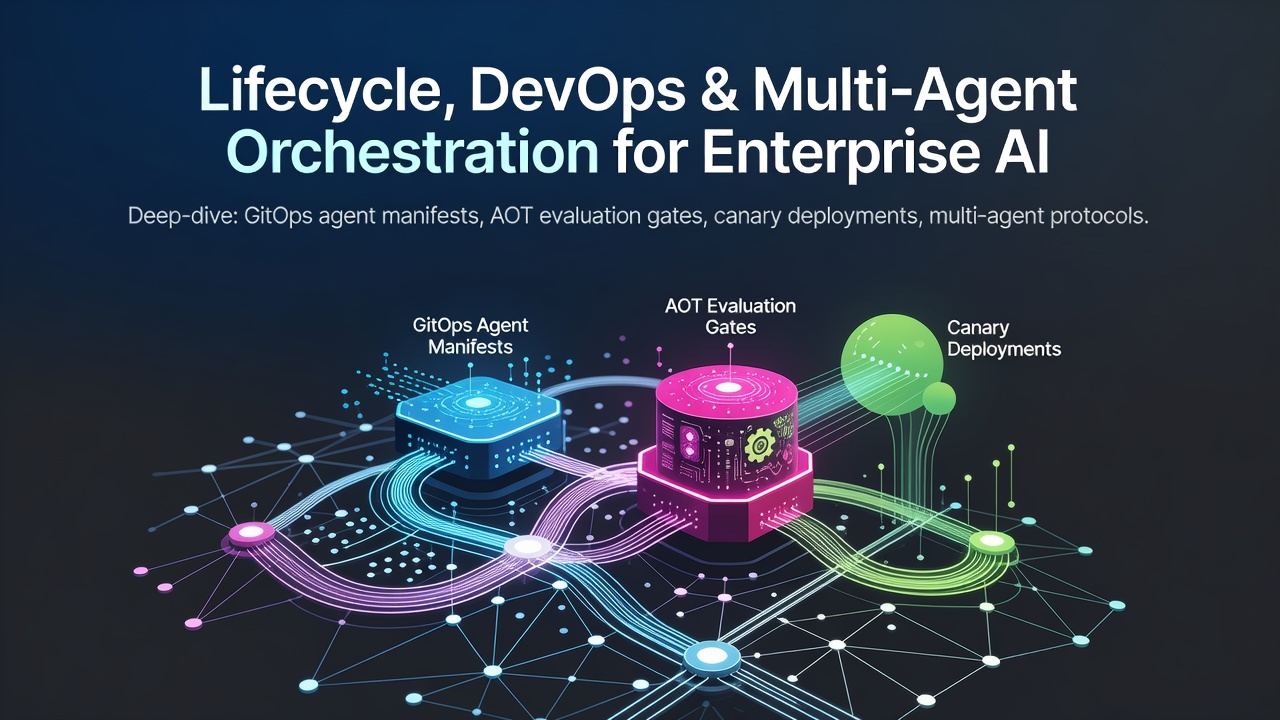
To operate multi-agent systems reliably in production, platform teams must implement Lifecycle, DevOps & Multi-Agent Orchestration—a framework combining GitOps pipelines, Ahead-of-Time (AOT) evaluation gates, progressive canary releases, and standardized inter-agent communication protocols.
Deep-Dive Architecture: GitOps & Multi-Agent Mesh
A. Declarative Agent Manifests & Versioning
Instead of storing system prompts and tool bindings in database tables or third-party SaaS consoles, platform engineering teams define agents declaratively using version-controlled manifests (e.g., YAML/JSON) packaged as signed OCI (Open Container Initiative) artifacts:
# Agent Declarative Manifest: finance-reconciler-v1.4.2.yaml
apiVersion: agent.governance.internal/v1alpha1
kind: AgentDeployment
metadata:
  name: finance-reconciler
  version: "1.4.2"
  gitCommit: "a8b9c1d2e3f4"
spec:
  model:
    provider: "google_vertex"
    name: "gemini-1.5-pro"
    parameters:
      temperature: 0.1
      top_p: 0.95
  systemPromptRef: "prompts/finance_reconciler_v1.4.2.txt"
  tools:
    - name: "sap_ledger_query"
      mcpServer: "[https://mcp-sap.internal](https://mcp-sap.internal)"
      schemaRef: "schemas/tools/sap_ledger_v2.json"
  evalSuiteRef: "evals/golden_finance_benchmark_v3.json"
  governance:
    maxRecursionDepth: 5
    allowedDelegations: ["tax-validator", "audit-logger"]
Enter fullscreen mode Exit fullscreen mode
B. Agentic CI/CD & Ahead-of-Time (AOT) Evaluation Gates
Before any pull request modifying an agent manifest is merged into the main branch, the CI/CD pipeline triggers an automated Ahead-of-Time (AOT) Evaluation Gate.
Synthetic Evaluation Runs
Execute candidate agent versions against predefined golden benchmark datasets.
Metric Verification
Evaluate candidate agents using automated frameworks such as Ragas or DeepEval across key dimensions:
- Faithfulness & groundedness
- Tool-calling accuracy
- Prompt injection resistance
- Token budget and latency consumption
Merge Gate
Automatically block pull requests when evaluation scores fall below established baseline thresholds.
C. Progressive Canary Releases & Automated Rollbacks
Continuous Deployment (CD) controllers such as Argo Rollouts or Istio orchestrate progressive canary deployments.
Traffic Splitting
- 10% of production traffic is routed to the candidate version.
- 90% continues running on the stable baseline.
Real-Time Monitoring
Monitor live production execution metrics using OpenTelemetry telemetry streams.
Automated Rollback
Automatically revert traffic to the stable baseline whenever error rates or tool failure rates exceed predefined thresholds.
The 3 Non-Negotiable Rules for Agentic DevOps
1. Prompts, Tools & Hyperparameters Are Code
Never edit system prompts or model parameters directly in production web interfaces.
Every change must:
- Be committed to Git
- Go through Pull Request review
- Pass automated CI/CD pipelines
2. No Production Deployment Without AOT Evaluation Gates
Every candidate agent version must be validated against deterministic golden evaluation datasets before deployment.
3. Enforce Boundary Isolation in Multi-Agent Meshes
Inter-agent communication must enforce:
- Strict protocol boundaries
- Token scope minimization
- Stateful recursion limits
- Safe delegation policies
This prevents rogue or compromised sub-agents from destabilizing the overall system.
Architect's Take
DevOps for autonomous AI agents is not simply traditional software engineering with an LLM attached.
Production-ready Agentic AI platforms require:
- Rigorous automated evaluation pipelines
- Version-controlled prompts, tools, and models
- Continuous validation before deployment
- Progressive delivery with automated rollback
- Strong operational boundaries between collaborating agents
Treat prompts as code, validate every build, and deploy incrementally with continuous observability.
Sources & References
Google Cloud – Building Production-Ready AI Agents with Vertex AI & Agent Development Kit - https://cloud.google.com/vertex-ai
LangChain – LangGraph & Multi-Agent Architecture Design Patterns - https://www.langchain.com/langgraph
Ragas – Enterprise Evaluation Framework for RAG & Agentic Systems - https://docs.ragas.io
Argo Workflows & Rollouts – Progressive Delivery Strategies for Kubernetes - https://argoproj.github.io/rollouts/
OWASP – Top 10 for Large Language Model Applications — Supply Chain & Plugin Governance - https://owasp.org/www-project-top-10-for-large-language-model-applications/
About Me
I'm an Enterprise Cloud & AI Architect with 14+ years of experience helping organizations design, build, and scale enterprise-grade cloud platforms, AI systems, and automation solutions.
Feel free to connect with me on LinkedIn or X (Twitter) at @jitu028.
For 1:1 architecture mentoring and guidance, visit my Topmate.
0 Comments
Log in to join the conversation.No comments yet. Be the first to share your thoughts.