
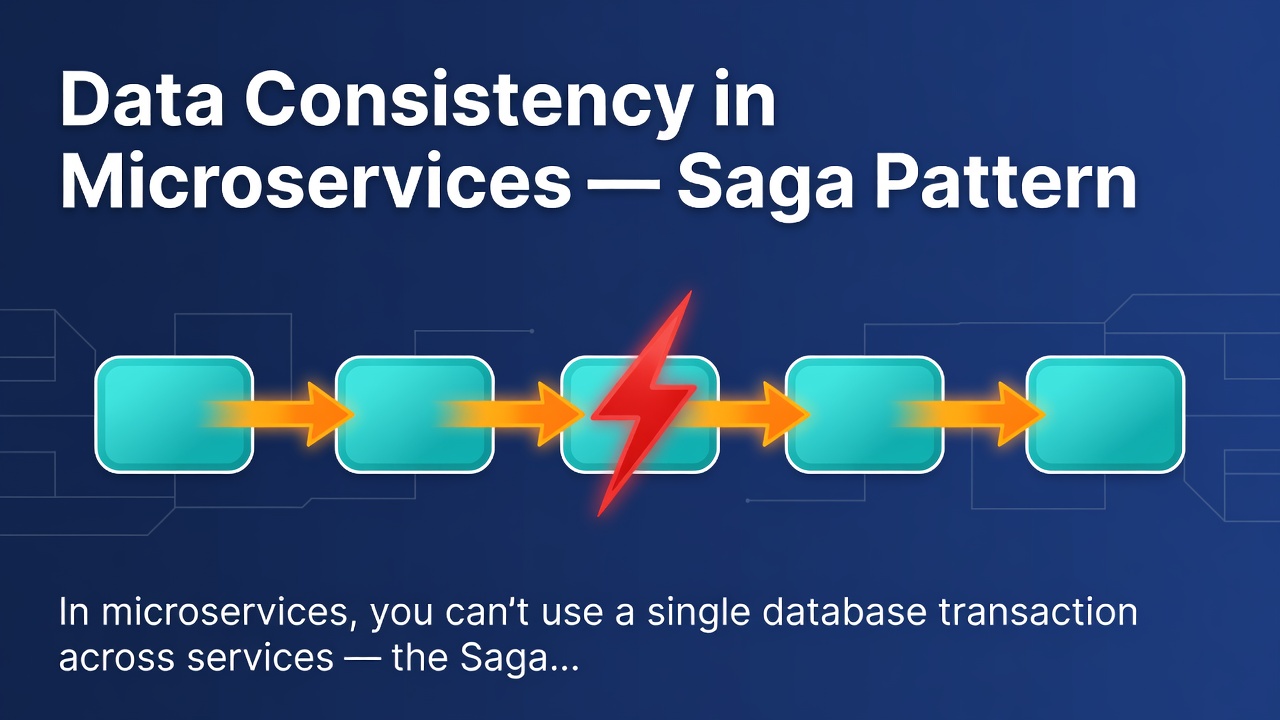


One-liner: In microservices, you can't use a single database transaction across services — the Saga pattern breaks it into a sequence of local transactions with compensating rollbacks on failure.
❓ The Problem: Distributed Transactions
In a monolith, you can wrap everything in one DB transaction:
BEGIN;
  UPDATE orders SET status='confirmed' WHERE id=1;
  UPDATE inventory SET stock=stock-1 WHERE product_id=5;
  INSERT INTO payments (order_id, amount) VALUES (1, 99.99);
COMMIT; -- all or nothing
Enter fullscreen mode Exit fullscreen mode
In microservices, each service owns its own DB. You cannot do a cross-service ACID transaction. If the payment service fails after inventory was deducted, you're in an inconsistent state.
🎭 The Saga Pattern
A Saga is a sequence of local transactions. Each step publishes an event triggering the next. If any step fails, compensating transactions undo the previous steps.
Example: E-commerce Order Flow
Step 1: Order Service      → Create order (PENDING)
Step 2: Inventory Service  → Reserve items
Step 3: Payment Service    → Charge customer
Step 4: Shipping Service   → Schedule delivery
Step 5: Order Service      → Mark order CONFIRMED
Enter fullscreen mode Exit fullscreen mode
Happy path ✅:
Order Created → Items Reserved → Payment Charged → Shipping Scheduled → Done ✅
Enter fullscreen mode Exit fullscreen mode
Failure at Payment ❌:
Order Created → Items Reserved → Payment FAILED
                                       ↓
                          Compensate: Release inventory
                          Compensate: Cancel order
Enter fullscreen mode Exit fullscreen mode
🏗️ Two Implementation Styles
1. Choreography (Event-driven, decentralized)
Each service listens for events and reacts. No central coordinator.
OrderService    ──publishes──► "OrderCreated"
InventoryService ──listens──► reserves stock, publishes "StockReserved"
PaymentService  ──listens──► charges card, publishes "PaymentProcessed"
ShippingService ──listens──► schedules delivery, publishes "Shipped"

On failure:
PaymentService publishes "PaymentFailed"
InventoryService listens, releases stock, publishes "StockReleased"
OrderService listens, marks order CANCELLED
Enter fullscreen mode Exit fullscreen mode
Pros: Simple, decoupled, no single point of failure
Cons: Hard to track overall saga state, cyclic dependencies possible
2. Orchestration (Centralized coordinator)
A dedicated Saga Orchestrator tells each service what to do.
                    ┌─────────────────────┐
                    │   Saga Orchestrator  │
                    │   (Order Saga)       │
                    └──────────┬──────────┘
                               │
         ┌─────────────────────┼──────────────────────┐
         ▼                     ▼                       ▼
  InventoryService       PaymentService          ShippingService
  "Reserve stock"        "Charge $99"            "Ship to addr"
  → "Reserved" ✅        → "Failed" ❌           (not called)
         │                     │
         └─────────────────────┘
                    Orchestrator receives "Failed"
                    → tells InventoryService: "Release stock"
                    → marks saga FAILED
Enter fullscreen mode Exit fullscreen mode
Pros: Clear saga state, easy to audit and debug
Cons: Orchestrator is a bottleneck / SPOF if not designed carefully
🆚 Choreography vs Orchestration
| Choreography | Orchestration | |
|---|---|---|
| Control | Decentralized | Centralized |
| Coupling | Loose (events) | Tighter (direct calls) |
| Visibility | Hard to trace end-to-end | Easy — one place to look |
| Complexity | Low per-service, high overall | High orchestrator logic |
| Best for | 3-4 step sagas | Complex, many-step flows |
💾 Saga State Storage
Track saga state to survive crashes:
CREATE TABLE sagas (
  id UUID PRIMARY KEY,
  type VARCHAR(50),          -- 'order_saga'
  current_step VARCHAR(50),  -- 'awaiting_payment'
  status VARCHAR(20),        -- 'IN_PROGRESS', 'COMPLETED', 'FAILED'
  payload JSONB,             -- order details
  created_at TIMESTAMP,
  updated_at TIMESTAMP
);
Enter fullscreen mode Exit fullscreen mode
✅ Pros
- Maintains data consistency without distributed transactions
- Works with polyglot persistence (each service uses its own DB)
- Choreography scales well horizontally
- Orchestration provides clear audit trail
❌ Cons
- Eventual consistency — data temporarily inconsistent between steps
- Compensating transactions are complex to implement correctly
- Hard to debug when something fails mid-saga
- Idempotency required for every step (retries happen)
⚖️ When to Use / When NOT to Use
✅ Use when:
- Multi-service workflows that must be atomic (order → payment → shipping)
- Different services own different databases
- Long-running business processes (insurance claims, loan approvals)
❌ Avoid when:
- Single service with one DB (just use a DB transaction)
- Simple async operations that don't need rollback
- You can redesign to avoid the distributed write entirely
0 Comments
Log in to join the conversation.No comments yet. Be the first to share your thoughts.