
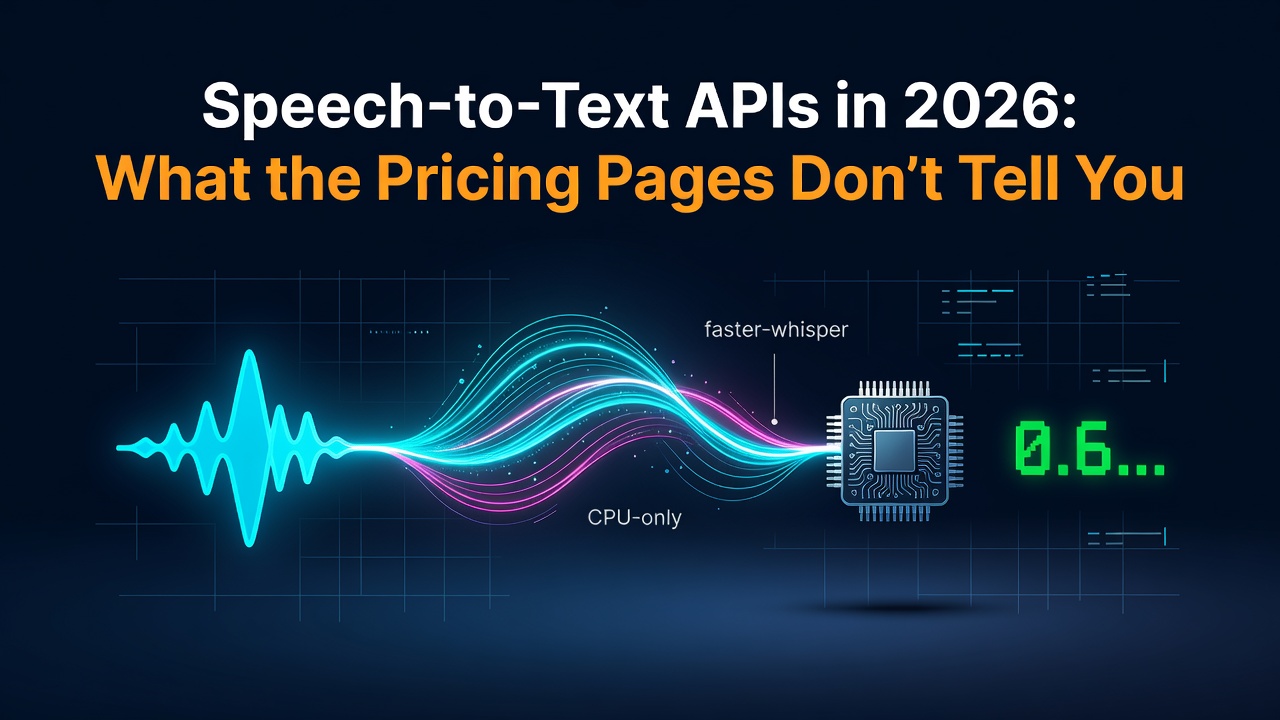


I ran a 9-second WAV file through faster-whisper on a CPU with no GPU and no API key. It took 0.6 seconds and got one word wrong: "Dev Tulab" instead of "DevToolLab". Adding one line of vocabulary hinting fixed it, for free. I wrote up the full comparison of hosted and open speech-to-text APIs on DevToolLab; here's the short version.
One Label, Three Different Jobs
"Speech-to-text" actually covers three separate problems. Batch transcription (a file already on disk, latency doesn't matter, cost per hour and jargon accuracy do). Real-time streaming for voice agents, where the hard part isn't the transcript, it's turn detection: knowing the caller paused versus finished talking. And text-to-speech, turning the reply back into audio.
The best model for one job is often the wrong pick for another. A model tuned for clean batch accuracy is not what you want driving a phone agent, and the fastest streaming model isn't the one you want transcribing a two-hour deposition.
Where Accuracy Actually Sits in 2026
A July 2026 benchmark across 14 commercial models put Speechmatics Melia-1 on top at 6.4% aggregate word error rate, with AssemblyAI Universal-3.5 Pro close behind at 7.0%, and Deepgram Nova-3 at 8.9%. Melia's real edge isn't the score, it's code-switching: it handles 56+ languages in a single pass with no language hint required, so a sentence that starts in Spanish and ends in English comes out right instead of mangled at the boundary. It's also priced from $0.129/hour, cheaper than the competition it beats.
The accuracy gap between the top hosted providers has narrowed to about 2.5 points of WER, which is smaller than the gap between clean and noisy audio. For most apps, that means accuracy alone shouldn't decide your vendor anymore.
The Feature That Actually Matters: Keyterm Prompting
If your product has its own vocabulary, product names, SKUs, drug names, this is the one feature worth prioritizing over a marginal accuracy score. AssemblyAI's Universal-3.5 Pro takes up to 1,000 keyterms and biases transcription toward them:
import assemblyai as aai

aai.settings.api_key = "YOUR_API_KEY"

config = aai.TranscriptionConfig(
    speech_models=["universal-3-5-pro"],
    keyterms_prompt=["DevToolLab", "Nova-3", "WER"],
)

transcript = aai.Transcriber(config=config).transcribe("meeting.mp3")
print(transcript.text)
Enter fullscreen mode Exit fullscreen mode
The open-source equivalent is Whisper's initial_prompt argument, the exact line that turned "Dev Tulab" into "DevToolLab" in my test above. Either way, one sentence of vocabulary hinting is often worth more than switching vendors for a 1-point WER improvement. I go deeper on pricing add-ons and how they stack in the full post, because this is where bills quietly triple.
For Voice Agents, Turn Detection Beats Everything Else
Most streaming pipelines still guess a speaker is done using a silence timer, which is why voice agents talk over people or go silent for two awkward seconds. Deepgram's Flux moves end-of-turn detection inside the model itself, deciding in under 400ms whether the person is actually finished, and emitting it as an event (EndOfTurn, TurnResumed if they start talking again). No amount of transcription accuracy fixes a bad turn-taking guess; this is the one architectural difference that matters for agents specifically.
Open Source Closed the Gap
Self-hosting stopped being a compromise in the last year or so. NVIDIA's Parakeet TDT 0.6B v3 hits 6.32% average WER at a throughput of over 3,000x real time on an A100, meaning it can chew through an hour of audio in about a second. Whisper large-v3 still covers more languages (99) than any commercial API. Moonshine runs up to 5x faster than Whisper on edge devices like a Raspberry Pi. If your volume is high or your data is sensitive, run the free baseline first and only pay for a hosted API once you know it beats it.
What Actually Bites You: Billing, Not Accuracy
Two things wreck cost models that nobody puts on the pricing page. First, streaming is sometimes billed on connection-open time, not audio sent, so an idle WebSocket left open while a user reads the page costs the same as one carrying speech. Second, add-ons stack additively: diarization, entity detection, and topic detection can each tack 5-15 cents onto an hourly rate, and stacking four of them can triple your bill from the cheapest-looking base rate. Price the configuration you'll actually ship, not the headline number.
References
- Best Speech-to-Text and AI Voice APIs in 2026 (full comparison, pricing tables, and code) - original article on DevToolLab
- Speechmatics pricing
- AssemblyAI pricing
- Deepgram Flux
- NVIDIA Parakeet TDT 0.6B v3
- Try it yourself: Speech to Text and Microphone Test on DevToolLab
0 Comments
Log in to join the conversation.No comments yet. Be the first to share your thoughts.