
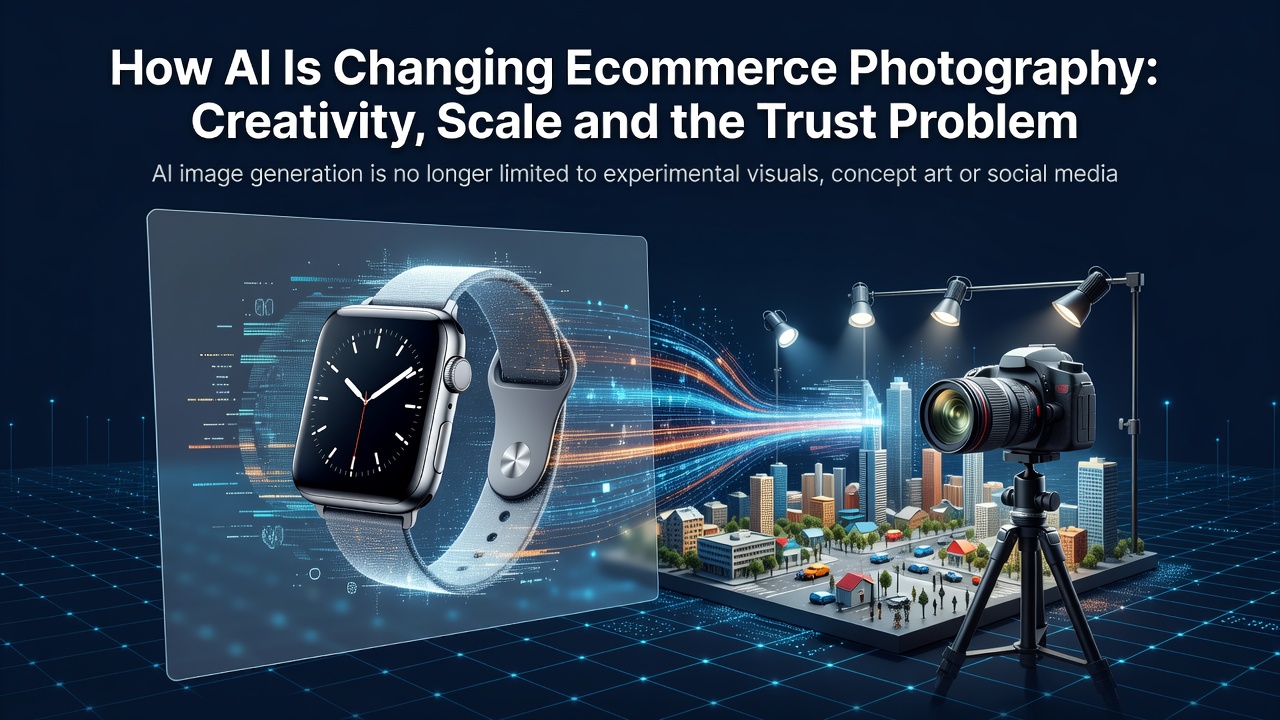
AI image generation is no longer limited to experimental visuals, concept art or social media trends.
It is becoming part of real ecommerce production systems.
Online stores are using artificial intelligence to remove backgrounds, generate lifestyle environments, adapt product images to different formats, create advertising variations and prepare visual assets for multiple markets.
A single product photograph can now become:
- a marketplace listing image;
- a lifestyle scene;
- an Instagram campaign;
- an email banner;
- a seasonal advertisement;
- a vertical video;
- or a localized visual for another audience.
This is often presented as a faster way to create product images.
But speed is only part of the change.
AI is transforming ecommerce photography from a fixed collection of finished photographs into a flexible visual system that can be continuously adapted, tested and expanded.
For developers, designers and AI product teams, the important question is no longer whether generative tools can create attractive product images.
The more difficult question is:
Can those images be generated at scale without changing the product customers are actually buying?
That tension between creativity, scale and trust is becoming one of the defining challenges of AI-assisted ecommerce.
Ecommerce Photography Is Moving Beyond the Photoshoot
Traditional product photography is organized around a production event.
A product arrives at a studio. A photographer prepares the lighting. A stylist arranges the set. The team captures a limited number of angles, retouches the selected images and distributes the final assets across product pages, advertisements and social media.
Once the shoot is finished, producing additional images often requires another round of planning.
That model works when a brand needs a small number of carefully directed photographs.
It becomes less efficient when one product must appear across:
- marketplace listings;
- product-detail pages;
- social media;
- email campaigns;
- display ads;
- landing pages;
- seasonal promotions;
- international storefronts;
- and multiple mobile formats.
AI changes what happens after the original photograph is captured.
Instead of treating each image as a final asset, a team can treat accurate product photography as verified source material.
From that source, it can generate new environments, layouts, dimensions and campaign variations without rebuilding the complete production every time.
This changes the question teams ask before a shoot.
It is no longer only:
Which photographs do we need today?
It becomes:
Which source images will give us the greatest creative and technical flexibility later?
What an AI Ecommerce Photography System Actually Needs
An image generator is only one part of an AI-assisted product photography system.
A reliable workflow usually combines several layers:
- verified source photography;
- clean product masks or transparent cutouts;
- generative background tools;
- image editing and upscaling;
- reference images;
- reusable prompt structures;
- brand guidelines;
- automated format adaptation;
- product-accuracy checks;
- metadata and asset management;
- and final human approval.
The larger challenge is not generating one impressive image.
It is maintaining product identity while many variations are created.
A system that produces hundreds of outputs must control more than visual style. It must protect the details that define the product.
Those details may include:
- dimensions;
- shape;
- color;
- packaging;
- logos;
- printed text;
- materials;
- reflections;
- accessories;
- and product function.
Without that protection, automation can scale errors as efficiently as it scales content.
One Product Can Now Live in Many Visual Worlds
The most visible creative advantage of AI is variation.
A perfume bottle can appear in a minimal studio, a botanical environment, a luxury hotel or a dark cinematic campaign.
A chair can be placed inside several interior styles.
A skincare product can move from a clean white-background image to a seasonal lifestyle campaign in minutes.
But convincing ecommerce imagery requires more than replacing the background.
The complete composition must still account for:
- lighting direction;
- shadow softness;
- product scale;
- camera angle;
- perspective;
- reflections;
- depth of field;
- surrounding materials;
- and the visual language of the brand.
AI can generate almost any setting.
That does not mean every setting is useful.
A product should not appear in a futuristic laboratory, tropical forest or luxury penthouse simply because the software can create it.
The scene still needs to communicate something relevant about the product, the audience or the brand.
Without art direction, generative ecommerce photography quickly becomes polished but interchangeable.
Creative Exploration Becomes Faster
Physical production requires commitment.
A team chooses a concept, books a location, prepares props, builds the set and hopes the idea works once everything is assembled.
Generative tools make early exploration faster and less expensive.
Before investing in a physical production, a creative team can test:
- several background colors;
- different surfaces;
- lighting directions;
- seasonal concepts;
- framing options;
- prop combinations;
- and campaign moods.
This is one of the most useful applications of AI for professional photographers and designers.
The technology can function as a visual sketchbook.
A generated study can help the team answer questions before production begins:
- Does the product disappear against this background?
- Does the image feel premium or generic?
- Is the lighting too cold?
- Does the environment support the product story?
- Can the concept expand into social media and video?
- Is the product still the visual priority?
Some concepts may remain fully synthetic.
Others may become references for real photography.
The value lies in improving the final creative decision.
The Real Advantage Is Scale
Most AI photography demonstrations show a single transformation.
A basic product photograph becomes a dramatic lifestyle image.
For ecommerce businesses, the larger advantage is scale.
Retailers do not manage one image. They manage catalogs containing many products, colors, sizes, packaging variations and seasonal updates.
Every asset may need to appear in multiple dimensions and on several platforms.
AI can accelerate repetitive tasks such as:
- background removal;
- image cleanup;
- canvas extension;
- resizing;
- basic relighting;
- resolution enhancement;
- shadow creation;
- and campaign variation.
This allows creative teams to spend less time manually rebuilding the same asset for every placement.
It also makes campaigns more specific.
Instead of forcing one hero image to work everywhere, a brand can create:
- different scenes for different audience segments;
- localized backgrounds for different markets;
- visuals for narrow advertising placements;
- seasonal updates;
- and multiple creative variants for testing.
Scale Introduces Visual Drift
Scaling AI-generated imagery also exposes a major weakness: inconsistency.
One generated image may look convincing in isolation.
A complete product grid may reveal:
- changing camera heights;
- inconsistent shadows;
- altered proportions;
- different color temperatures;
- unstable packaging;
- distorted logos;
- or gradual changes in the product shape.
This is often described as visual drift.
It matters because ecommerce catalogs are built for comparison.
Customers scan multiple products and variations together. If every image follows a different visual logic, the store becomes harder to understand and the brand feels less reliable.
A scalable system therefore needs stable references and rules.
Useful controls may include:
- approved camera angles;
- fixed aspect ratios;
- consistent product scale;
- shared lighting references;
- reusable background templates;
- seed control where available;
- product-specific masks;
- and automated or manual comparison against source images.
A better prompt can improve an output.
It cannot replace a complete quality-control process.
Product Accuracy Is the New Creative Constraint
In editorial illustration, an invented detail may be part of the concept.
In ecommerce photography, an invented detail can become a false promise.
A product image is not only decorative.
It is evidence customers use to decide whether they should buy something.
That means several attributes must remain accurate.
Shape and proportions
The product outline should match the real object.
A model should not make a bottle taller, a chair wider or a device thinner simply to improve the composition.
Color
The displayed color should remain close to the product the customer will receive.
Lighting can change mood, but it should not create a different product variation.
Material
Glass, metal, leather, fabric and plastic respond to light differently.
A generated image can accidentally make an inexpensive material appear more premium or change the apparent texture.
Packaging and text
Logos, product names, measurements and instructions must remain correct.
Generative models are still unreliable with small typography and packaging details.
Quantity and accessories
An image should not imply that additional objects are included when they are only decorative props.
Function
The scene must not suggest a capability the product does not have.
A generated image of a waterproof device underwater, for example, may communicate a technical claim rather than a purely visual idea.
Photorealism Is Not the Same as Truth
A generated image may have realistic shadows, excellent lighting and convincing textures while still showing the wrong product.
This is one of the most important risks of generative ecommerce imagery.
Obvious visual errors are easy to reject.
Subtle changes can pass through production because the image looks professional at first glance.
Every AI-assisted product image should therefore be evaluated with two separate questions:
- Does the image look visually convincing?
- Does the image accurately represent the real product?
The second question is more important.
A commercially reliable image must satisfy both.
The Trust Problem
Ecommerce has always depended on a gap between image and object.
The customer sees a photograph on a screen and receives a physical product later.
Good product photography narrows that gap. It helps the customer understand the object before purchasing it.
Poorly controlled AI imagery can widen it.
The trust problem begins when a generated image improves the appearance of a product by changing something the customer would consider important.
Examples include:
- a bottle appearing larger than it is;
- a fabric looking softer or thicker;
- jewelry appearing more reflective;
- food containing ingredients that are not included;
- furniture appearing larger than its real dimensions;
- or packaging showing text that does not exist.
These changes may not be intentional.
A model may introduce them while attempting to create a more coherent or visually dramatic composition.
The customer experiences the result, not the intention.
Trust Is a Business Metric
A misleading image may increase attention or clicks in the short term.
It can also produce:
- higher return rates;
- negative reviews;
- customer-support complaints;
- marketplace-policy issues;
- lower repeat-purchase rates;
- and long-term damage to brand credibility.
The strongest ecommerce image is not necessarily the most dramatic.
It is the image that makes the product desirable without making it unrecognizable.
For AI teams, this means visual quality should not be measured only through aesthetics.
A production system may also need to track:
- correction rates;
- rejected-image rates;
- product-detail errors;
- return reasons;
- customer complaints;
- and manual review time.
These signals can reveal whether the system is producing useful commercial assets or merely attractive outputs.
Catalog, Lifestyle and Conceptual Images Need Different Rules
Not every ecommerce image serves the same function.
Catalog imagery
Catalog images should present the product as clearly and accurately as possible.
This is where strict product preservation matters most.
Lifestyle imagery
Lifestyle images can create atmosphere and context, but the product should remain faithful to reality.
The environment may be generated. The object should still be correct.
Conceptual campaign imagery
Conceptual advertising can use metaphor, fantasy and exaggeration.
The creative intent should be clear, and the image should not be presented as straightforward evidence of the product.
Problems occur when a highly conceptual image is used as though it were an accurate product reference.
The closer the image is to the purchasing decision, the stricter the accuracy standard should be.
Virtual Models and Synthetic Photoshoots
Fashion and beauty ecommerce are moving beyond generated backgrounds.
AI systems can now create on-model images, modify poses, visualize clothing in different environments and generate campaign-style assets without organizing a traditional shoot for every variation.
Potential benefits include:
- faster campaign localization;
- more model variations;
- new poses and environments;
- additional visual content for short product cycles;
- and lower production costs for secondary assets.
But virtual models introduce new risks.
Garment behavior must remain credible
An image must communicate:
- how the fabric drapes;
- where the garment fits closely;
- the real length;
- pattern alignment;
- seam placement;
- and how the material behaves in motion.
An attractive image can still create a false expectation about fit.
Representation requires more than prompts
It is technically easy to request different ages, body types and appearances.
That does not automatically create meaningful or respectful representation.
Styling, cultural context and the way people are portrayed still require human judgment.
Will AI Replace Ecommerce Photographers?
Some tasks are already becoming automated.
Background removal, basic cleanup, resizing and repetitive catalog variations require less manual work than before.
But professional product photography involves far more than operating a camera.
A photographer controls:
- light;
- reflections;
- perspective;
- material appearance;
- visual hierarchy;
- composition;
- and product truth.
AI can generate options.
It cannot remove the need to judge those options.
The photographer’s role is likely to become broader.
Future ecommerce photographers may work across:
- source photography;
- creative direction;
- reference development;
- generative tools;
- image selection;
- retouching;
- consistency control;
- and product verification.
Repetitive execution may become less valuable.
Judgment becomes more valuable.
The Future Is Hybrid
The most reliable future for ecommerce photography is not a complete replacement of cameras with prompts.
It is a hybrid system.
Real photography provides product truth.
AI provides speed, variation and creative range.
Human review determines whether the final image is commercially usable.
A practical hybrid process may look like this:
- Photograph the real product accurately.
- Prepare clean source images and masks.
- Use AI to explore environments and formats.
- Refine the strongest outputs.
- Compare every result with the real product.
- Approve assets for specific channels.
- Store the source and generated files separately.
This approach does not force brands to choose between authenticity and efficiency.
The product remains real.
The creative possibilities become wider.
A Technical Workflow for AI Product Images
A production-ready system may include the following stages.
1. Asset ingestion
Upload verified source photographs, transparent cutouts, product dimensions and brand references.
2. Product isolation
Create accurate masks or alpha channels that protect the product from unwanted reconstruction.
3. Scene generation
Generate backgrounds, surfaces and environmental elements around the protected product.
4. Composition and lighting
Match perspective, shadows, reflections and lighting direction.
5. Automated validation
Run basic checks for:
- image dimensions;
- missing files;
- incorrect aspect ratios;
- blank outputs;
- and low resolution.
More advanced systems may also use image similarity or computer vision to compare the generated product with the reference.
6. Human review
A designer, photographer or product specialist confirms:
- product fidelity;
- text accuracy;
- material consistency;
- realistic scale;
- and commercial suitability.
7. Export and delivery
Generate platform-specific versions for marketplaces, advertisements, websites and social media.
The image generator is only one component.
The production value comes from the entire system.
What Ecommerce Teams Should Do Now
Brands do not need to choose between using AI everywhere and avoiding it completely.
They need clear rules.
Define the role of every image
Decide whether the asset is intended for:
- a primary listing;
- a product gallery;
- a lifestyle section;
- a paid ad;
- a social post;
- or a conceptual campaign.
Protect the product
Use accurate source photographs, masks and references whenever possible.
Avoid asking the model to redraw the entire object unless the result is clearly conceptual.
Create an accuracy checklist
Review:
- shape;
- color;
- material;
- packaging;
- logos;
- text;
- accessories;
- and function.
Separate creative and product approval
An art director may approve the visual concept.
A product specialist should verify that the item remains correct.
In a smaller team, one person may perform both roles, but both reviews are still necessary.
Store production history
Keep:
- the original image;
- masks;
- prompt versions;
- generated outputs;
- edited files;
- and final exports.
This makes errors easier to trace and campaigns easier to update.
Creativity Needs Accountability
AI is making ecommerce photography faster, more flexible and more accessible.
Small brands can explore visual concepts that once required larger budgets.
Established retailers can update large catalogs more efficiently.
Designers and photographers can test ideas before committing to physical production.
But the ability to generate more images does not automatically create a stronger visual system.
When technically polished imagery becomes abundant, differentiation will depend on:
- taste;
- consistency;
- product accuracy;
- brand identity;
- and trust.
The brands that benefit most from AI will not be the ones that produce the highest number of synthetic images.
They will be the ones that establish the clearest line between enhancement and deception, creative possibility and product truth.
For DesignRise, the future of ecommerce photography is not a choice between human creativity and artificial intelligence.
It is a new creative discipline built around both.
Real photography provides evidence.
AI provides scale and experimentation.
Human judgment determines whether the final image deserves to be trusted.
This is a condensed and technically adapted version of the full DesignRise analysis, which also covers virtual photoshoots, disclosure, category-specific risks and the changing role of photographers.
Read the complete article on DesignRise:
How AI Is Changing Ecommerce Photography: Creativity, Scale and the Trust Problem
Enter fullscreen mode Exit fullscreen mode
0 Comments
Log in to join the conversation.No comments yet. Be the first to share your thoughts.