
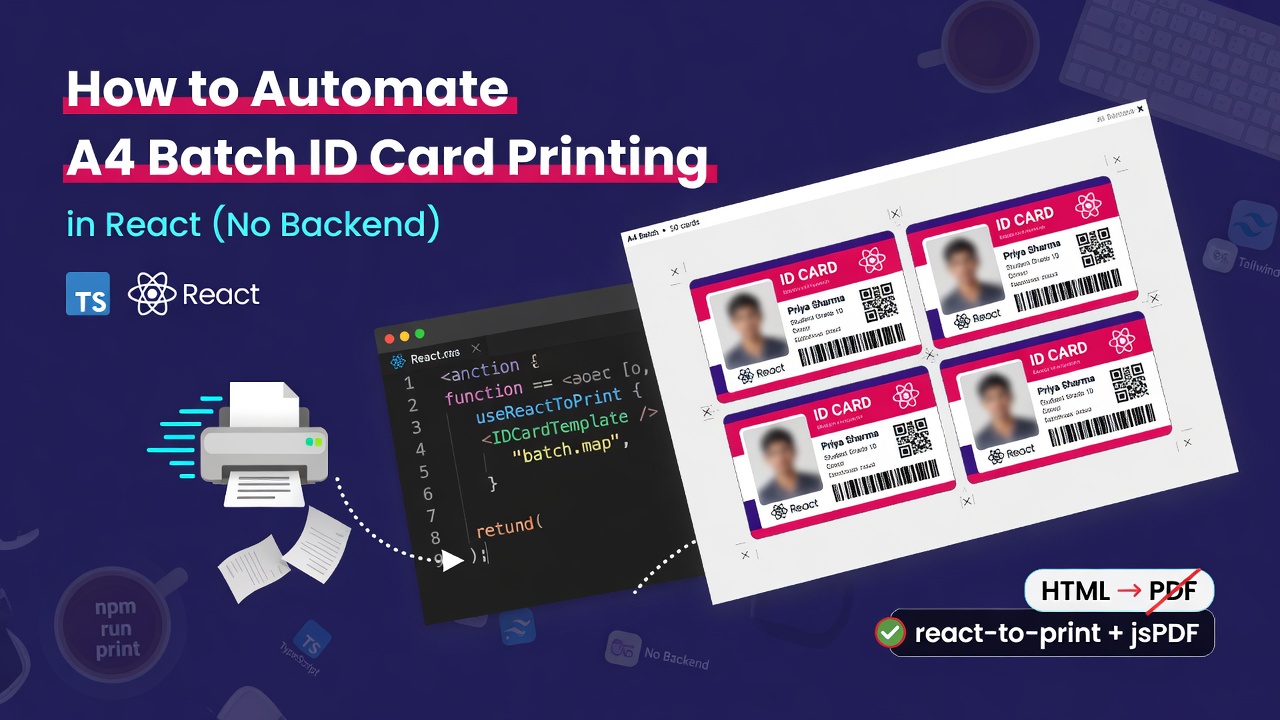

The Nightmare of HTML-to-PDF in React
If you’ve ever built a School ERP, HR portal, or Event Management system, you’ve probably hit this exact wall: Your client needs to print 5,000 ID cards or badges.
Usually, this forces frontend teams to do one of two terrible things:
Pay for an expensive backend PDF generation API (which raises huge GDPR/privacy concerns because you have to send sensitive employee photos to a 3rd-party server).
Force the non-technical HR team to manually type names into Canva, crop photos, and manually drag them onto an A4 grid (an 80-hour manual data entry nightmare).
I got tired of rebuilding complex html2canvas and jsPDF calculators from scratch for every project. So, I decided to automate the entire pipeline natively in the browser.
Enter @stratametriq/id-card-designer — an open-source, turnkey drag-and-drop ID card studio and A4 mathematical rendering engine for React.
What it does out of the box:
Instead of building a canvas from scratch, you install this NPM package in one line of code. It gives your end-users a complete visual dashboard directly inside your own application.
Here is a 60-second video of how it looks running in a live production environment: 👉 https://youtu.be/l9aXWqRSFCM?si=nEIaaqsxypmzCflm
The Core Features:
Dynamic Handlebars Data Binding Your users can design a visual template and drop in tags like {{studentName}} or {{employeeId}}. Our engine automatically binds these variables to your live database array. No manual typing required.
Scannable Barcodes & QR Codes We built native QR and Barcode generators directly into the canvas. You just pass the ID string, and the engine renders a scannable vector code instantly.
The Magic Moment: Precision A4 Batch Matrix When your HR admin selects 500 employees and hits "Batch Print", the real magic happens. Our client-side mathematical matrix calculates exact millimeter dimensions—arranging exactly nine PVC cards perfectly on standard A4 cut-sheets, complete with professional 0.35mm hardware crosshair cut-marks. It generates a 50-page PDF in under 3 seconds.
100% Client-Side Security Because this runs entirely in the browser DOM, your highly sensitive corporate data, employee records, and student photographs never touch an external server. It is inherently GDPR-compliant.
How to use it in your React/Next.js App
Installation is incredibly simple. Just install the NPM package:
npm install @stratametriq/id-card-designer
Then mount the component and import the stylesheet:
import React from 'react';
import { IdCardManager } from '@stratametriq/id-card-designer';
import '@stratametriq/id-card-designer/dist/index.css';
export default function MyDashboard() {
return (
);
}
That’s it. You just saved your engineering team 3 months of development time.
Open-Source vs. Commercial
We dual-licensed the engine to help as many developers as possible.
You can install and use the MIT Open-Source version for free right now on NPM to build non-commercial or standard apps.
If you are a SaaS company, ERP provider, or enterprise looking to completely white-label the software (remove all our logos) and embed it into your proprietary software, you can grab the Commercial Enterprise License on our website!
👉 NPM Link: [https://www.npmjs.com/package/@stratametriq/id-card-designer] 👉 Get the Enterprise License: [https://waniabid.gumroad.com/l/id-card-designer-pro]
Let me know in the comments if you have ever struggled with React PDF generation! I'd love to hear your horror stories.
0 Comments
Log in to join the conversation.No comments yet. Be the first to share your thoughts.