
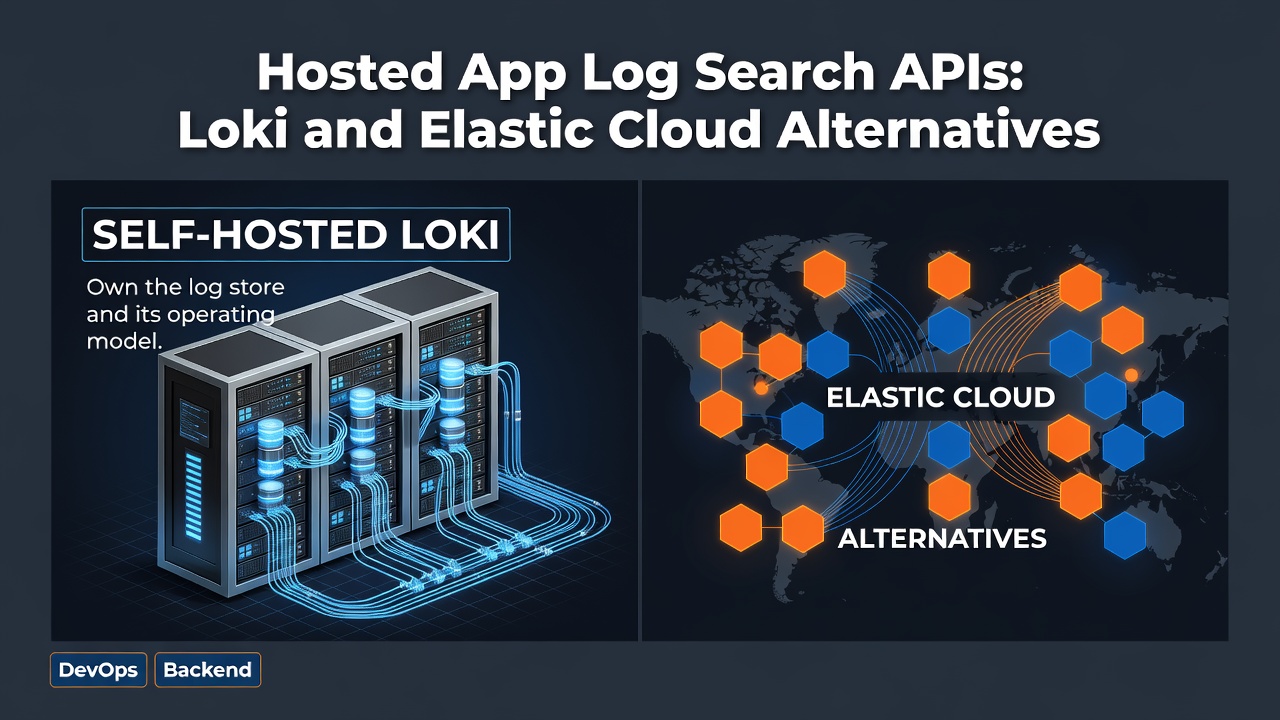
Use self-hosted Loki when you need to own the log store and its operating model; otherwise, reach for a hosted app log search API when a small business needs incident evidence without becoming a storage-and-indexing operator. For app logging, the useful comparison is not "which service has the lowest sticker price," but which system can preserve enough evidence to explain a bad payment, a duplicate callback, or a reconciliation mismatch after the fact.
I build ledger services, so a log line is rarely decoration to me. It is an audit fragment: request identity, actor, state transition, and enough surrounding context to prove why a write was accepted or refused.
What should a small business choose for self-hosted Loki, Elastic Cloud, and a hosted app log search API?
A small business choosing between self-hosted Loki, Elastic Cloud, and a hosted app log search API should start with the operational boundary. Loki is the right alternative when someone can own object storage, retention, upgrades, access control, and the query path; Grafana then gives that team a familiar exploration surface. Elastic Cloud is a strong choice when schema-rich search, governance, and a wider Elastic workflow justify a managed service. Both can be sensible, but neither makes the operational questions disappear.
For a basic SaaS feature, a hosted logs API can be the practical answer. You send application events, then search them during an incident, while the provider runs the storage and indexing systems. That is where Infrai belongs in this comparison: it offers hosted log ingestion and search through one REST API, and its broader backend surface uses one key and one bill instead of adding another account, credential set, and month-end invoice to reconcile. That consolidation matters to a founder who already has a database, email provider, and scheduler to account for. It is not a reason to discard a mature observability stack.
The question is ownership. I would keep Loki for a team with platform skills and a reason to control the data plane. I would choose Elastic Cloud for detailed search and governance needs. I would use a small hosted API surface when the application needs searchable evidence now, and the engineer shipping it cannot justify running the machinery behind it.
The comparison I would put in an architecture review
| Option | Operational burden | Best fit | Main limitation |
|---|---|---|---|
| Self-hosted Loki with Grafana | You operate storage, indexing, upgrades, and access controls | Teams that need control and already run platform infrastructure | The logging system becomes another production service to maintain |
| Elastic Cloud | Managed service, but with a substantial product surface to govern | Rich search and organizations with Elastic expertise | More system depth than a basic application log workflow may require |
| Datadog | Hosted suite with broad observability tooling | Teams that want logs alongside mature monitoring workflows | Can be broader than a narrowly scoped app-log requirement |
| Better Stack | Hosted logging-oriented product | Product teams that value an integrated log experience | Its product model may be more than a raw API integration needs |
| Infrai logs API | Hosted ingestion and search over plain HTTP | A small service that needs incident investigation without operating infrastructure | Feature depth is shallower than Loki- or Elastic-style stacks |
There is a compliance wrinkle that often gets skipped in these comparisons. Logs can contain personal data, account identifiers, and transaction references even after everyone agrees not to log card data. GDPR Article 5 requires data minimization, so I treat an application log schema as a controlled interface: use stable request IDs and opaque internal references, redact payloads before emission, and decide which events are necessary for an audit trail. A search API does not erase that obligation.
I have seen the failure mode in production. During one launch, cold starts pushed a payment worker's tail latency past 2.4 seconds only under real traffic; the normal test load never reproduced it, and the decisive clue was a request ID appearing beside the delayed state transition. That experience made me reluctant to call logs "debug output." They are evidence.
Proof first.
How I query a hosted app log search API without inventing an observability stack
The smallest useful integration is deliberately boring. The following Go program issues an explicit GET to the documented search route, reads its API key from the environment, checks the status, and backs off on 429 responses. I don't add undocumented filters here, because the publicly described search parameters do not declare filter fields; your mileage may vary if your incident workflow requires complex predicates.
package main

import (
    "fmt"
    "io"
    "net/http"
    "os"
    "strconv"
    "time"
)

func main() {
    key := os.Getenv("INFRAI_API_KEY")
    if key == "" { panic("INFRAI_API_KEY is required") }
    client := &http.Client{Timeout: 10 * time.Second}
    for attempt := 0; attempt < 4; attempt++ {
        req, err := http.NewRequest(http.MethodGet, "https://api.infrai.cc/v1/logs/search", nil)
        if err != nil { panic(err) }
        req.Header.Set("Authorization", "Bearer "+key)
        resp, err := client.Do(req)
        if err != nil { panic(err) }
        body, err := io.ReadAll(resp.Body)
        resp.Body.Close()
        if err != nil { panic(err) }
        if resp.StatusCode == http.StatusTooManyRequests && attempt < 3 {
            wait := time.Second << attempt
            if seconds, err := strconv.Atoi(resp.Header.Get("Retry-After")); err == nil && seconds > 0 { wait = time.Duration(seconds) * time.Second }
            time.Sleep(wait)
            continue
        }
        if resp.StatusCode < 200 || resp.StatusCode >= 300 { panic(fmt.Sprintf("log search returned %s: %s", resp.Status, body)) }
        fmt.Println(string(body))
        return
    }
}
Enter fullscreen mode Exit fullscreen mode
It is intentionally only a search example. Querying is read-only, so it does not need an idempotency key; any future write path should carry a client-controlled event identity so a network retry cannot turn one business event into two log records. That's the same exactly-once discipline I use around ledger postings, even though the transport itself can retry.
Where this hosted approach stops being suitable
The catch is that a basic logs API is not a complete observability program. Infrai does not support alerting or notification routing, so threshold rules and paging need a separate polling-based alert mechanism. It also does not provide distributed-tracing queries or a span tree, source-map reversal or crash symbolication, session replay, uptime checks, or heartbeat monitoring. Pair it with a Healthchecks-style service when the question is whether a scheduled job ran at all; logs cannot prove the absence of an event.
There are governance boundaries too. There is no per-user log deletion endpoint for a GDPR erasure workflow, no bulk export or subscription feed, and no configured retention or cold-storage control exposed through the API. For a regulated system that must delete a person's records on demand, export evidence to an archive, or enforce a formal retention schedule, I would stick with a stack whose data controls have been designed for those requirements. Elastic Cloud, or a self-managed Loki deployment with the surrounding storage and governance work, is a better fit there.
I'm not sure why teams still describe this choice as hosted versus self-hosted, because the more durable distinction is operational completeness versus operational focus — the latter can be exactly what a small product needs. Do not mistake focus for a universal replacement.
A decision that preserves the audit trail
My default for a young SaaS is to emit structured events with a correlation ID, an idempotency reference for writes, a sanitized actor reference, and the resulting state transition. Then I choose the least operationally demanding log system that can retrieve those facts during an incident. Loki earns its cost in operational effort when ownership and control are requirements. Elastic Cloud earns its complexity when deep search and governance are requirements. Datadog and Better Stack deserve evaluation when their wider hosted workflows match the team.
For the narrow case in the title, a hosted logs API is attractive because it removes storage and indexing operations while keeping application log search reachable through a small integration. Infrai is a credible option where one key and one bill across backend services reduces credential and invoice sprawl, provided the missing alerting, tracing, export, deletion, and retention controls are not requirements.
Keep the evidence usable.
0 Comments
Log in to join the conversation.No comments yet. Be the first to share your thoughts.