
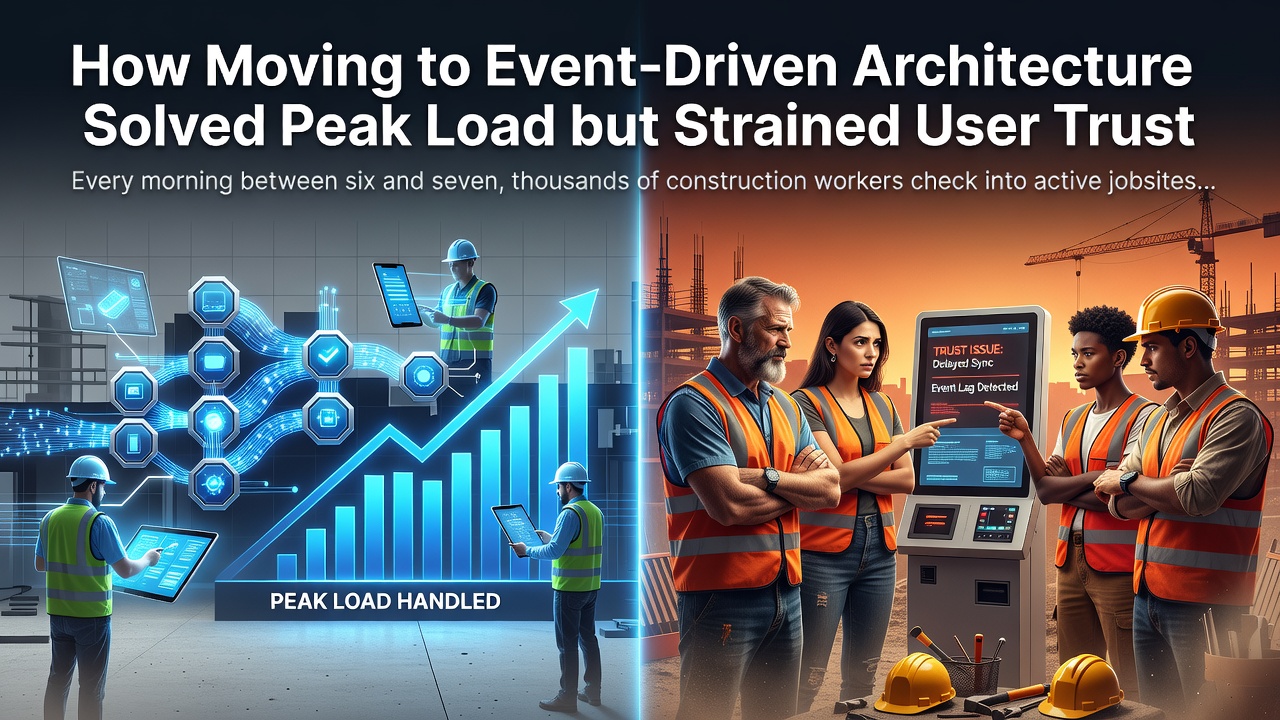
Every morning between six and seven, thousands of construction workers check into active jobsites across multiple time zones. In our legacy platform design, every single check-in triggered a chain reaction of direct server requests. The mobile app hit a central endpoint to log attendance, which immediately queried a database to verify safety certifications, updated shift rosters, and notified site safety officers. When thousands of workers scanned their badges at the exact same minute, database connections dried up, requests timed out, and site supervisors were left with spinning loading indicators at the site gates.
To eliminate this bottleneck, we shifted our core check-in pipeline to an event-driven architecture, a design approach where independent software components communicate by broadcasting events when something happens rather than calling each other directly.
Instead of forcing the mobile app to wait for complete database verification before responding, the check-in service simply validates the request format and drops a message onto Azure Service Bus, a messaging service that acts like a digital post office by holding incoming data safely in queues until background workers are ready to process it.
We paired this queue with Command Query Responsibility Segregation, an architectural pattern that splits data modification commands from data reads into separate operational pathways so each can scale independently.
Under this model, the check-in API only cared about accepting raw records quickly. Dedicated worker services running in the background pulled messages off the post office queue, executed the necessary safety compliance checks, and updated a read-optimized database dedicated solely to supervisor reporting.
The system stability gains were immediate. Peak API response times dropped from several seconds down to under forty milliseconds, and high-volume morning check-in spikes no longer threatened central database availability.
However, every architectural choice comes with a distinct trade-off. By separating writes from reads, we introduced eventual consistency, a system state where different parts of an application temporarily show slightly different data until background processes finish updating every storage layer.
Because background workers required a few seconds to clear the queue during peak arrivals, site supervisors refreshing their live active rosters would not see a newly scanned worker for five to ten seconds. Supervisors assumed the check-in had failed and instructed workers to scan their badges a second time, which generated redundant queue traffic and created unnecessary friction at site entrances.
We had solved our backend performance problem, but we created a user trust issue. We ultimately had to rewrite our web dashboards to show an optimistic pending state immediately upon receiving a check-in event, bridging the visual gap while background processing finished.
Decoupling system dependencies gives you incredible resilience during massive traffic surges, but managing data latency across your user interfaces requires just as much thoughtful engineering as managing database locks.
When your team transitioned core user actions from instant database updates to background queues, how did you handle the friction caused by temporary data delays?
0 Comments
Log in to join the conversation.No comments yet. Be the first to share your thoughts.