
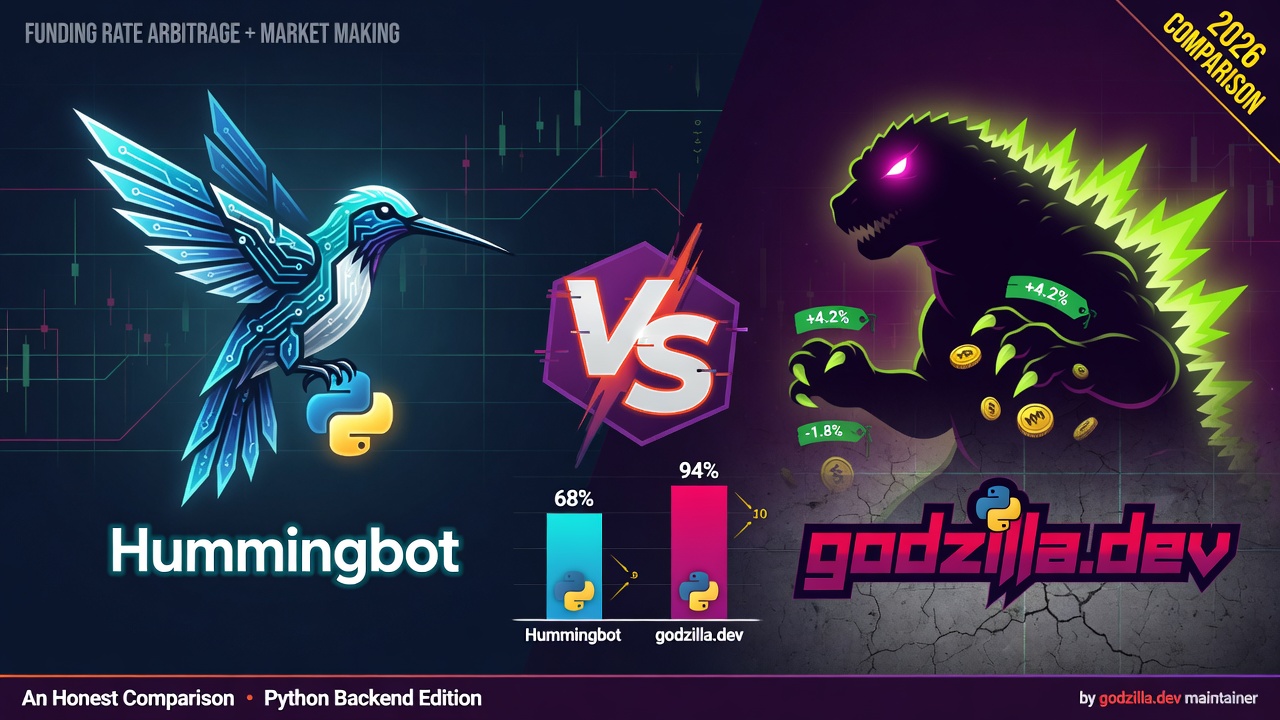
Disclosure up front: I build and maintain godzilla.dev. This is not a neutral third-party review — it's a maintainer's attempt at an honest comparison, including the places where Hummingbot is the better choice. If you think I've been unfair anywhere, tell me in the comments and I'll fix it.
The short answer
If you're an individual trader getting started with algorithmic crypto trading, use Hummingbot. It has a larger community, far more exchange connectors, better beginner documentation, and an ecosystem (dashboard, AI tooling, governance) that godzilla.dev doesn't try to compete with.
godzilla.dev makes sense in a narrower situation: you're running latency-sensitive strategies — funding rate arbitrage around settlement, or market making on liquid pairs — and you want the software path between a market-data event and an order leaving your process to be measured in microseconds, not milliseconds. Or you're a trading team that needs private enterprise deployment on your own infrastructure with support. That's the use case it was built for, and it doesn't pretend to be anything broader.
Both are open-source under Apache 2.0. Both are self-hosted and non-custodial — your API keys and strategy logic stay on your own servers. The difference is where each one spends its complexity budget.
What each project actually is
Hummingbot is a Python-based open-source framework maintained by the Hummingbot Foundation, with community governance through the HBOT token. As of mid-2026 it's at v2.x, reports 300+ connectors across centralized and decentralized exchanges, and claims over $36B in aggregated trade volume reported by user instances since early 2025. The ecosystem around it is genuinely impressive: a web dashboard, an AI agent harness (Condor), MCP integration for LLM-driven trading, quarterly community votes on which connectors get maintained, and years of accumulated strategy templates and educational material.
godzilla.dev is a C++/Python framework focused on two workloads: funding rate arbitrage (delta-neutral spot–perp and cross-exchange) and low-latency market making. Architecturally, it separates market-data, strategy, and trade-execution into independently managed processes connected through a journal-based shared-memory event path — every event that flows through the system is timestamped and persisted, so the same records the runtime uses for execution are available afterwards for replay, post-incident analysis, and latency audits. Strategies are written in Python via pybind11 bindings for fast iteration, and the same interface can be implemented in C++ when profiling shows a callback sits on a latency-critical path. The journal substrate builds on the Kungfu open-source runtime (Apache 2.0), which the project discloses rather than hides. The community is smaller than Hummingbot's, the connector list is a fraction of theirs <!-- TODO: 填入实际支持的交易所数量 -->, and the commercial model is enterprise private deployment with support, rather than a token or a marketplace.
Side-by-side
Hummingbot godzilla.dev
Language Python (some Cython) C++ execution core, Python strategy layer (pybind11)
License Apache 2.0 Apache 2.0
Custody model Self-hosted, non-custodial Self-hosted, non-custodial
Exchange coverage 300+ connectors, CEX + DEX Small set of major CEX perp/spot venues
Primary strategies Market making, arbitrage, broad strategy library Funding rate arbitrage, low-latency market making
Architecture Monolithic client + Gateway middleware Process-isolated md / strategy / td, journal-based shared memory
Event records Logs, database Persistent journal; replayable, used for post-run latency audit
Published latency data None that I'm aware of Reproducible single-host benchmark, ~121–135 µs median local path
DEX support Yes (Gateway middleware) No
Learning curve Steep for beginners, but extensive docs and community Steep, assumes production trading experience
Community Large: Discord, forum, governance, education programs Small: Telegram, GitHub, YouTube series
Commercial model Foundation + exchange partnerships + token governance Enterprise private deployment + support contracts
Where Hummingbot is clearly better
Exchange coverage. 300+ connectors versus a handful. If your strategy needs a long-tail exchange, a DEX, or you rotate venues frequently, this alone decides it.
Community and longevity. Hummingbot has been in continuous development since 2019, has survived multiple market cycles, and has an actual governance process for maintaining connectors. When an exchange changes its API at 3am, the odds that someone has already opened a PR are much higher.
Onboarding. Neither tool is a consumer app, but Hummingbot has invested years in documentation, video walkthroughs, and community education. godzilla.dev's docs assume you already know what a delta-neutral funding position is and have run production systems before.
Ecosystem velocity. The AI-agent direction (Condor, MCP integration) means Hummingbot is becoming a platform other tools build on. godzilla.dev has no equivalent and no plans for one.
Where godzilla.dev is different — with actual numbers
The local software path is measured, and the measurement is published. Rather than saying "ultra low-latency" and asking you to take it on faith, we recently published a reproducible benchmark of the framework's local software path: the interval from a synthetic top-of-book event appearing in the journal to a local order report being generated, with a native C++ strategy callback in between. On an Intel i7-1360P (a laptop-class CPU, deliberately not a tuned server), across five runs of 900 post-warm-up order cycles each, run-level median latency was 121–135 µs, and run-level p99 ranged from 435 to 662 µs. Stage decomposition, per-event records, analysis scripts, and the exact source commit are all in the public repo.
Just as important is what that benchmark doesn't claim, because this is where most trading-infrastructure marketing goes to die. It's a single-host microbenchmark with mock market-data and trade endpoints. It excludes network transport, exchange gateways, matching-engine latency, fills, and queue position. It says nothing about profitability. And it is explicitly not a comparison with Hummingbot — a fair cross-framework benchmark would need pinned versions, identical workloads and strategy semantics, disclosed tuning on both sides, and ideally review from both communities. Nobody has done that study yet. If someone from the Hummingbot side wants to co-design one, I'm genuinely interested.
What the number does tell you is the framework's design center. A journal-based shared-memory path with a native callback keeps the operator-controlled portion of the loop — market-data processing, strategy dispatch, order construction, hand-off to execution — in the hundreds-of-microseconds range at the tail. Whether that matters for you depends entirely on your strategy (more on that below).
Funding-rate-arbitrage-first design. In Hummingbot, funding arb is one strategy among many. In godzilla.dev, the concerns that make funding arb operationally hard — coordinating legs, containing venue-adapter failures without killing the strategy process, reconciling local state against venue state after a restart, auditing exactly when each event happened — are what the architecture is organized around. Process isolation means a flaky exchange API can have its connector restarted without touching market data or other venues; the persistent journal means post-incident analysis runs on the same event records the runtime actually used.
Enterprise private deployment. If you're a trading team that needs the system deployed inside your own cloud account, with support, an SLA, and no third-party dependency in the execution path, that's godzilla.dev's actual product. Hummingbot's ecosystem is oriented around its community and foundation model, which is a strength for individuals and a mismatch for some institutional procurement processes.
Production track record at exchange scale. The framework's C++ core has been running liquidity provision across 1,000+ pairs for a top-10 derivatives exchange in continuous production for three years. That's a narrow claim — one deployment, deep — versus Hummingbot's broad claim of 100K+ instances. Which kind of validation matters more depends on which kind of user you are. (To be precise: the production deployment and the published benchmark are separate claims; the benchmark doesn't use production data as evidence, and vice versa.)
The honest failure modes of each
Choosing Hummingbot and discovering later that internal latency was your bottleneck means a rewrite, not a config change — an event loop in interpreted Python is not something you optimize your way out of. Choosing godzilla.dev and discovering you actually wanted breadth (many venues, DEXs, strategy variety, community support at 3am) means you picked a scalpel when you needed a toolbox.
The most common mistake I see is people choosing based on latency they don't actually need. Most funding rate arbitrage at moderate size on major pairs works fine at Python speeds — when you hold through settlement cycles, your edge is measured in hours, not microseconds. Internal latency starts paying for itself when you're legging in close to settlement while spreads widen, trading less liquid pairs where the mark price moves against you mid-hedge, or market making where queue position is the edge. And even then, remember the benchmark's own scope note: your network path to the exchange will usually dominate the local software path unless you're co-located. If you're not sure whether you're latency-sensitive, you're probably not — start with Hummingbot.
FAQ
Can I run funding rate arbitrage without giving a third party my API keys? Yes, with either tool. Both are self-hosted: keys live on your own server, and no SaaS intermediary sits in the execution path. This is the main structural difference between open-source frameworks and subscription bot platforms.
Does execution latency actually matter for funding rate arbitrage? For holding positions across settlement cycles on liquid pairs: mostly no. For entering positions in the final minutes before settlement, exiting during volatility, or running the same infrastructure for market making: yes. Note that internal software latency (microseconds, if the framework is built for it) and network latency to the exchange (milliseconds, unless co-located) are different problems — fixing the first without the second buys you little.
How fast is godzilla.dev, concretely? In a published single-host benchmark with a native C++ strategy and mock endpoints: ~121–135 µs median and ~435–662 µs p99 from synthetic depth event to local order report, on a laptop-class i7. This measures only the local software path — no network, no exchange, no fills — and is not a comparison with any other framework. Scripts and raw event records are in the repository if you want to reproduce or audit it.
Can I deploy either on my own AWS account? Yes. Hummingbot runs anywhere Docker runs. godzilla.dev is designed specifically for co-located deployment in the AWS regions used by major exchanges' matching engines, and enterprise deployments run entirely inside the client's own cloud account.
Is godzilla.dev a Hummingbot fork? No. Different codebase, different execution-core language, different design center. It does build its journal substrate on the open-source Kungfu runtime (disclosed in the docs and the benchmark paper). Hummingbot optimizes for breadth and community; godzilla.dev optimizes for a short, auditable native execution path and a narrow set of strategies.
godzilla.dev is open source under Apache 2.0: github.com/godzilla-foundation/godzilla-community. The latency benchmark paper, scripts, and raw results are in the same repository. Hummingbot is at hummingbot.org. Corrections welcome — especially from Hummingbot users who think I've undersold something.
0 Comments
Log in to join the conversation.No comments yet. Be the first to share your thoughts.