
[Submitted on 23 Jul 2026]
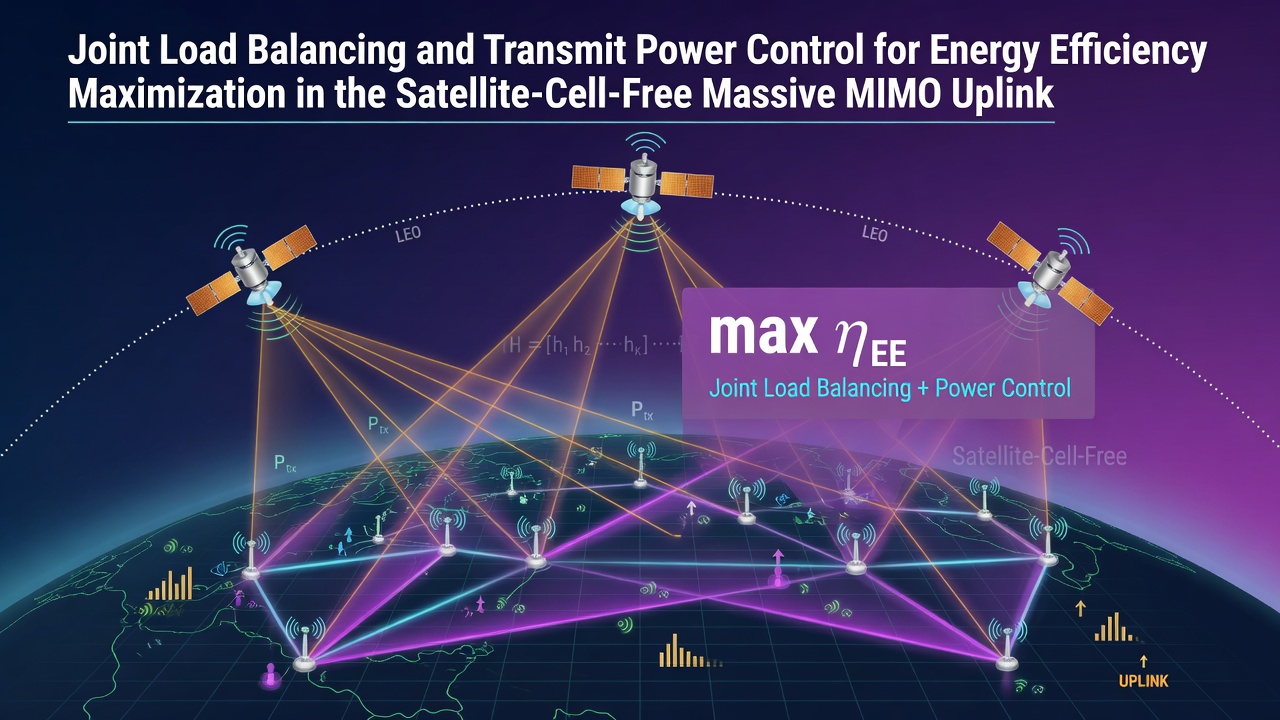
Abstract:The seamless integration of non-terrestrial and terrestrial infrastructures is a key enabler for ubiquitous connectivity in next-generation (NG) wireless networks. We investigate a hybrid satellite-cell-free Massive MIMO system, where multiple low-Earth-orbit (LEO) satellites jointly serve users in unison with terrestrial access points (APs) under realistic imperfect channel state information and practical user association constraints. We first derive closed-form expressions of the uplink ergodic throughput by exploiting maximum ratio combining (MRC) for transmission over spatially correlated Rician fading channels. Our analysis reveals the characteristic impact of both user-satellite and user-AP association patterns on both the spectral efficiency and rate-fairness achieved. We then formulate an energy efficiency optimization problem under joint user association and power control. Since the problems are inherently NP-hard due to the binary nature of the user-association variables, we develop an improved Differential Evolution (IDE) framework that efficiently explores the feasible solutions in polynomial time. Numerical results validate our analysis and show that the proposed hybrid scheme substantially improves energy efficiency and network throughput. For large-scale scenarios, the DE framework provides practical user-satellite-AP association guidelines, enabling scalable performance gains.
Submission history
From: Trinh Van Chien [view email]
[v1]
Thu, 23 Jul 2026 23:14:04 UTC (4,386 KB)
0 Comments
Log in to join the conversation.No comments yet. Be the first to share your thoughts.