
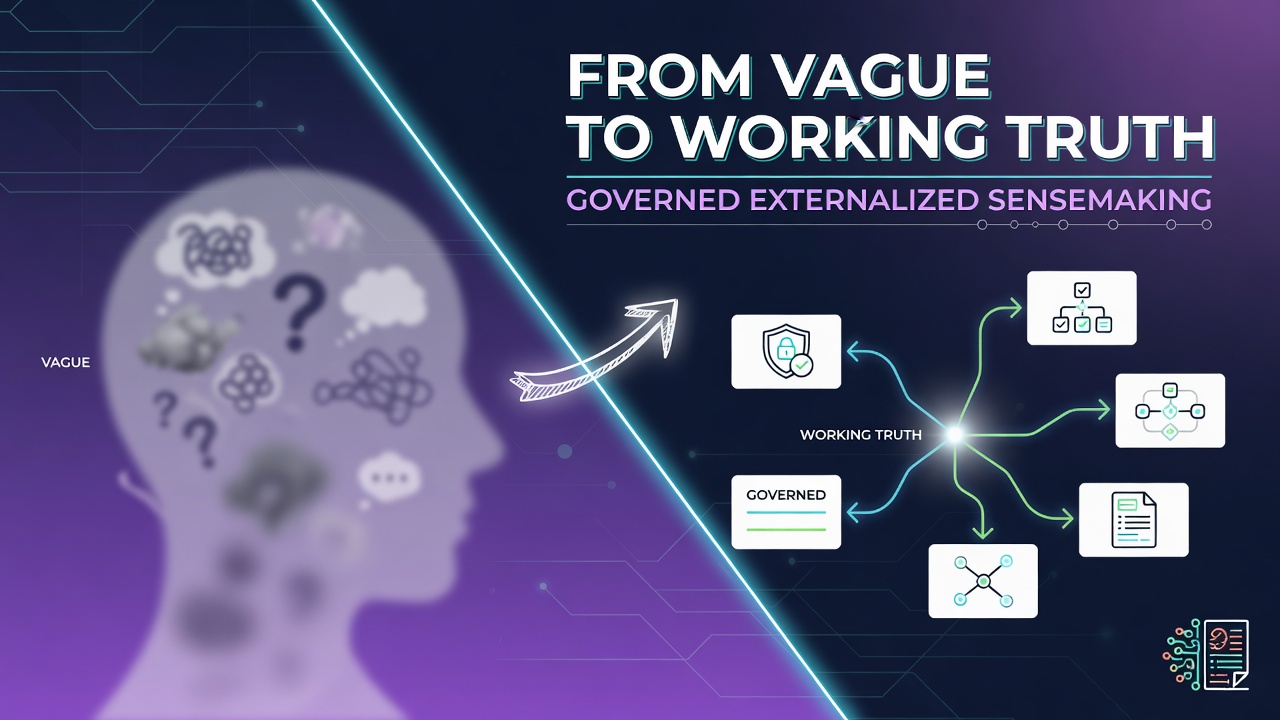
From Vague Understanding to Working Truth: Governed Externalized Sensemaking
This is a pre-polish article about a captured working model.
It came out of practical work on Myriuna Worlds, not from an academic research program. I was building, documenting, reviewing, and trying to keep a large AI-assisted project from dissolving into scattered notes, unfinished thoughts, and repeated re-discovery.
The model that emerged is called:
Governed Externalized Sensemaking
The short version:
Governed Externalized Sensemaking is a human-governed AI-assisted learning workflow where unstable early understanding is externalized into inspectable artifacts, tested through reframing and role-based metacognitive pressure, recorded as traceable provenance, exposed to external feedback, reviewed for authority, and promoted only when it becomes bounded working truth.
That is a large sentence, but the problem underneath it is simple:
A lot of useful understanding appears before it is polished enough to be recognized.
And many environments still behave as if the only meaningful states are:
wrong
right
pass
fail
done
not done
Enter fullscreen mode Exit fullscreen mode
That is too crude for how understanding often forms.
The problem: early understanding is often invisible
Sometimes you understand something before you can explain it.
Not fully. Not cleanly. Not in the correct terminology. Not in a form that would satisfy a teacher, manager, reviewer, or client.
But something is there.
A pattern.
A pressure.
A contradiction.
A shape.
A sense that the current framing is wrong.
A half-formed model that has not yet found its language.
In many systems, that state looks like failure.
The person cannot explain it yet, so it is treated as not understood.
But that is not always true.
Sometimes the understanding is real, but pre-formal.
It needs a bridge.
Pass/fail is a bad interface for unfinished understanding
This is where I think many education and working environments are too narrow.
Not because standards are bad.
Standards matter.
But pass/fail is often used too early. It evaluates the visible final answer while ignoring the formation route that produced it.
That works for some tasks. It fails badly for ambiguous work.
In complex learning, research, design, writing, systems thinking, product work, and self-directed learning, the interesting question is often not:
Is this right yet?
Enter fullscreen mode Exit fullscreen mode
It is:
What is forming here?
What resisted?
What changed?
What did the learner reject?
What survived contradiction?
What is still uncertain?
What can be tested next?
What deserves promotion, repair, or rejection?
Enter fullscreen mode Exit fullscreen mode
That requires a different interface.
The model
Governed Externalized Sensemaking describes that interface.
The core loop looks like this:
ill-structured problem space
-> early-stage sensemaking
-> exploratory probing
-> feedback / disconfirmation
-> cognitive conflict
-> context-sensitive conceptual potentiality
-> externalization prompt
-> external representation
-> cognitive offloading artifact
-> problem reframing
-> structured perspective-taking + metacognitive prompting
-> iterative multi-perspective refinement
-> conceptual stabilization
-> epistemic agency / reflective judgment
-> process trace / provenance
-> external validation / authentic feedback
-> review / evaluation / validation
-> candidate working truth
-> working truth
-> metacognitive governance
-> improved future learning
Enter fullscreen mode Exit fullscreen mode
In less formal language:
- You start with something vague.
- You externalize it before it disappears.
- AI gives you something visible to push against.
- You reframe it.
- You test it through different roles or perspectives.
- Contradictions expose weak parts.
- Surviving parts stabilize.
- You create a bounded trace.
- Reality answers through feedback, tests, people, code, documents, or failure.
- Review decides whether the result is rejected, repaired, archived, or promoted.
The important part is that the AI does not own the truth.
The AI is a responsive surface.
The human remains responsible for authority.
AI as a responsive surface
In a human-only workflow, vague understanding often has to be held internally while also being inspected, compared, translated, and remembered.
That is a lot to ask from one mind at once.
AI changes the workflow because the vague shape can be thrown into language earlier.
The first output may be wrong.
That is fine.
Wrong output is still useful if it creates boundary data.
No, not that.
That lost the shape.
That is too academic.
That is too vague.
That sounds true but has no evidence.
That belongs to another domain.
That is close.
That sentence holds.
Enter fullscreen mode Exit fullscreen mode
The AI does not need to be correct immediately to be useful.
It needs to make the unfinished understanding visible enough to inspect.
Role pressure
Once the idea is visible, it can be tested through roles.
Not imaginary employees. Not autonomous agents. Just bounded perspectives.
For example:
Research asks: what terms already exist?
Engineering asks: can this be built?
Governance asks: what claim is actually allowed?
Security asks: what breaks if this is wrong?
Product asks: who is this for?
Quality asks: how would failure be detected?
Archivist asks: where did this come from?
Enter fullscreen mode Exit fullscreen mode
The roles do not approve the idea.
They strike it.
A useful idea becomes stronger not because every role agrees, but because some part survives pressure from multiple directions.
That survival is not proof.
But it is a stabilization signal.
Working truth, not final truth
A major boundary in this model is the difference between:
raw capture
candidate working truth
working truth
external validation
Enter fullscreen mode Exit fullscreen mode
These are not the same.
A raw capture preserves the first shape.
A candidate working truth is reviewable but not fully authorized.
A working truth is accepted enough to guide bounded future work.
External validation requires pressure from outside the loop: another person, expert review, implementation, users, documents, tests, business reality, legal reality, or failure.
Working truth is not final truth.
It means:
This is accepted enough to use as a baseline for future work, with named limits, named uncertainty, and a preserved trace of how it got here.
The 36-minute reference frame
One useful observation from this project:
Once the raw human-language capture existed, the AI-assisted bridge workflow translated and anchored it into a sciences-facing compact model in approximately 36 minutes.
That does not prove the model is true.
It does not prove external validity.
It does not prove this works for everyone.
But it defeats one very common human objection:
This kind of translation takes way too long.
In this case, the workflow moved from raw capture to communicable model quickly because the formation route had been preserved.
That is the practical value.
The model is not only about thinking better.
It is about making thought easier to recover, inspect, translate, challenge, and reuse.
Who this might help
This may be useful for people and environments where meaningful understanding begins before it is polished enough to be recognized.
That includes:
- self-taught learners;
- students who understand through building before they know the accepted terminology;
- researchers and designers working in ambiguous spaces;
- writers and analysts trying to preserve formation routes;
- teachers and mentors who want to inspect reasoning instead of only grading final answers;
- neurodivergent or executive-function-fragile workers who struggle with trace loss or context loss;
- AI-assisted knowledge workers who need clearer boundaries between generation, review, and accepted authority.
This is not a request to lower standards.
It is a request to stop pretending that unfinished understanding is the same thing as failed understanding.
A better framing is:
Do not lower the bar. Improve the visibility of how people reach the bar.
What this is not
This is not a finished academic theory.
It is not peer reviewed.
It is not a universal method.
It is not an argument that AI should decide what is true.
It is not a productivity hack.
It is a captured working model with an evidence trail.
The current claim is modest:
Governed Externalized Sensemaking appears to be a useful model for describing and organizing an AI-assisted workflow where vague early understanding becomes visible, traceable, reviewable, and eventually promotable into bounded working truth.
That is enough to share.
Not as proof.
As an inspectable starting point.
Why I am publishing it now
I am publishing this before it is fully polished because the capture is complete enough to inspect.
The danger with this kind of work is that it either stays private forever because it is not polished, or it gets over-polished until the original shape disappears.
This is the middle state.
Pre-polish.
Traceable.
Bounded.
Open to pressure.
The evidence packet is available here:
Governed Externalized Sensemaking
Status: pre-polish capture, internally traceable candidate model
Origin: created during work on Myriuna Worlds
Project context: AI-assisted learning, sensemaking, reasoning traces, and human-governed knowledge work
Summary
Governed Externalized Sensemaking is a human-governed AI-assisted learning workflow for turning unstable early understanding into reviewable knowledge.
A learner begins with a vague or pre-formal idea, externalizes it into an inspectable artifact, tests it through reframing and role-based metacognitive pressure, records its formation as provenance, exposes it to external feedback, and promotes only reviewed results into bounded working truth.
The model is not presented here as a finished learning theory, academic validation claim, or universal method. This repository preserves the current evidence packet and compact model so the idea can be inspected, challenged, improved, or rejected without losing the path that formed it.
Why this exists
This work came out of practical development work for Myriuna Worlds. While building and documenting…
Project context:
this model emerged during work on Myriuna Worlds: https://myriunaworlds.com
Final formulation
Governed Externalized Sensemaking is a human-governed AI-assisted learning model in which unstable early understanding is externalized into inspectable artifacts, iteratively reframed and role-tested, preserved as process provenance, exposed to reality-facing validation, reviewed for authority, and promoted only as bounded working truth.
AI may assist.
Roles may pressure-test.
Artifacts may preserve.
Traces may make claims inspectable.
Reality may answer.
Review may promote.
But authority, responsibility, and accountability remain with the human learner.
0 Comments
Log in to join the conversation.No comments yet. Be the first to share your thoughts.