
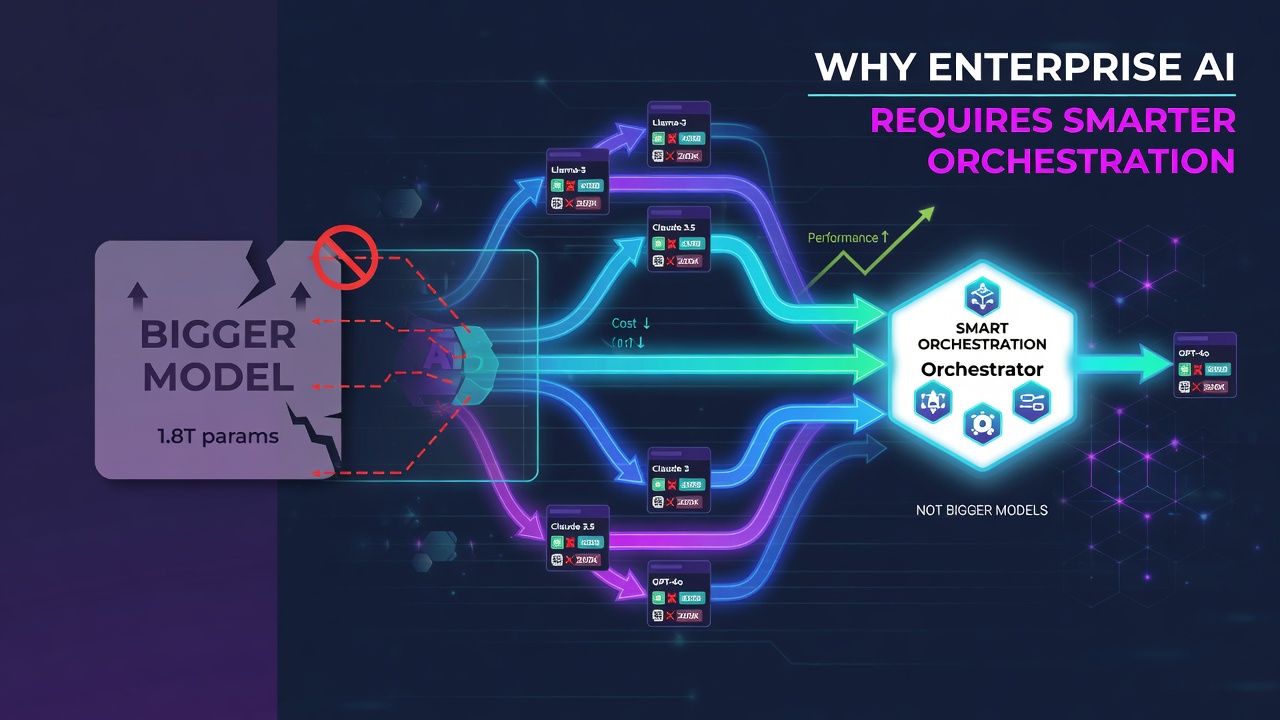

Every week, a new AI model launches with a larger context window, more parameters, or a higher benchmark score. The default assumption seems to be that the solution to complex enterprise problems is simply more model.
While building Project Sentinel, I came to a different conclusion.
The fastest AI inference is often the one you never have to perform.
Instead of treating the LLM as the center of the system, we designed an architecture where deterministic systems, metadata, retrieval, routing, and workflows eliminate unnecessary reasoning before a language model is ever called.
The result is an architecture that prioritizes efficiency, explainability, and enterprise reliability over raw model size.
In this technical whitepaper, I break down the architecture behind Project Sentinel, including:
Autonomous global event ingestion
A "Traffic Cop" routing layer for intelligent model selection
Hybrid retrieval combining structured filters, semantic search, and live web intelligence
Temporal query resolution for time-aware reasoning
Deterministic geopolitical risk scoring
Enterprise Bring-Your-Own-Data (BYOD) architecture
Workflow orchestration for autonomous intelligence operations
It's an engineering deep dive into the design decisions, trade-offs, and architectural principles behind building a real-time geopolitical intelligence platform.
If you're an AI engineer, platform architect, or systems engineer, I'd genuinely appreciate your feedback on the architecture.
0 Comments
Log in to join the conversation.No comments yet. Be the first to share your thoughts.