
[Submitted on 23 Jul 2026]
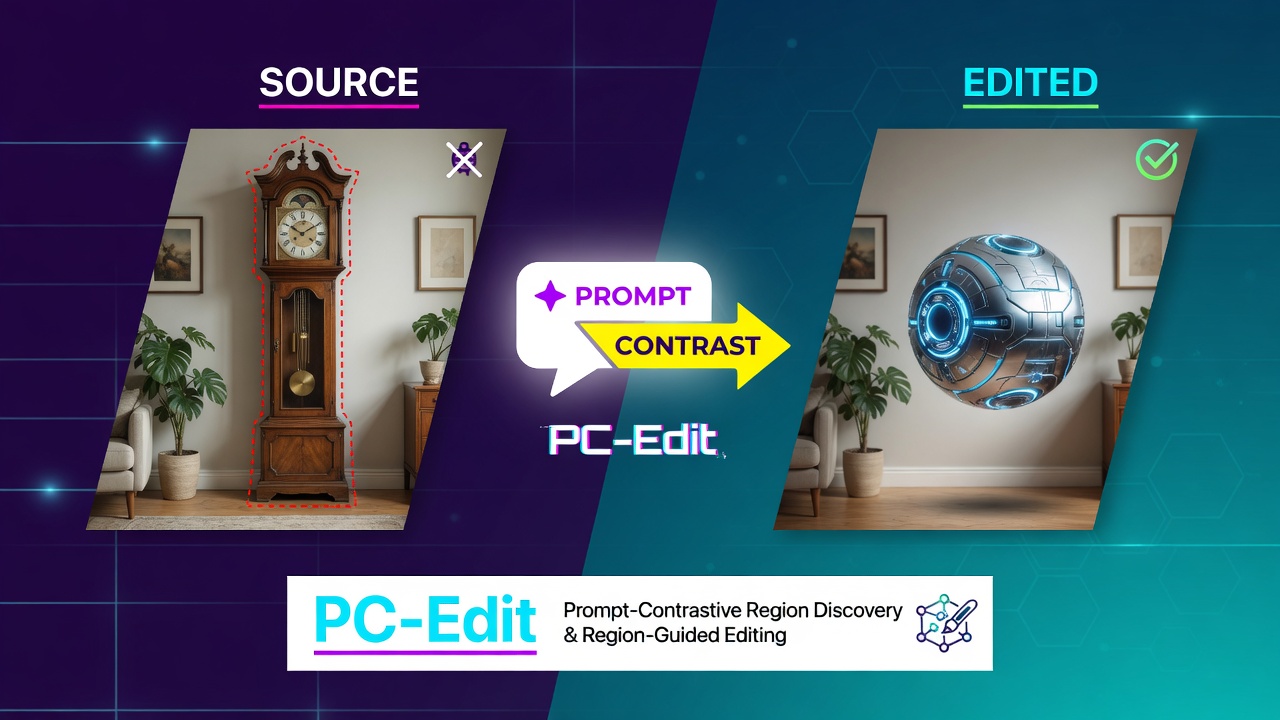
Abstract:Replacing an object with one that differs in category or shape requires complete source removal, natural target formation unconstrained by the source silhouette, and preservation of unrelated content. Existing training-free editors either localize edits from terminal predictions under source and target prompts or preserve unrelated content through spatially unselective source-feature reuse without explicit region discovery. Before reaching the terminal predictions, prompt-induced semantic differences undergo additional network transformations that may obscure their spatial localization, reducing localization precision. Spatially unselective feature reuse forces a trade-off between edit completeness and background preservation. Therefore, we propose PC-Edit, a prompt-contrastive framework for training-free MM-DiT editing. PC-Edit contrasts the image-token attention outputs under the source and target prompts, capturing prompt-induced semantic differences directly where text-conditioned information is delivered to image tokens. The same contrast identifies a source-erasure region during inversion and a target-emergence region during denoising. Their union suppresses source remnants while allowing the target object to form naturally. PC-Edit further couples region discovery and background preservation within each sampling step by estimating the current edit region from preceding attention blocks and immediately injecting cached source K/V features outside it in subsequent blocks, thereby protecting unrelated content before the latent update. Experiments on PIE-Bench and our EditRegion-Bench, with human-verified edit-region annotations for single- and multi-object addition and replacement, show that PC-Edit achieves the best editing quality and background preservation among methods without user-specified edit regions.
Submission history
From: Jian Zhang [view email]
[v1]
Thu, 23 Jul 2026 13:42:03 UTC (14,696 KB)
0 Comments
Log in to join the conversation.No comments yet. Be the first to share your thoughts.