
[Submitted on 22 Jul 2026]
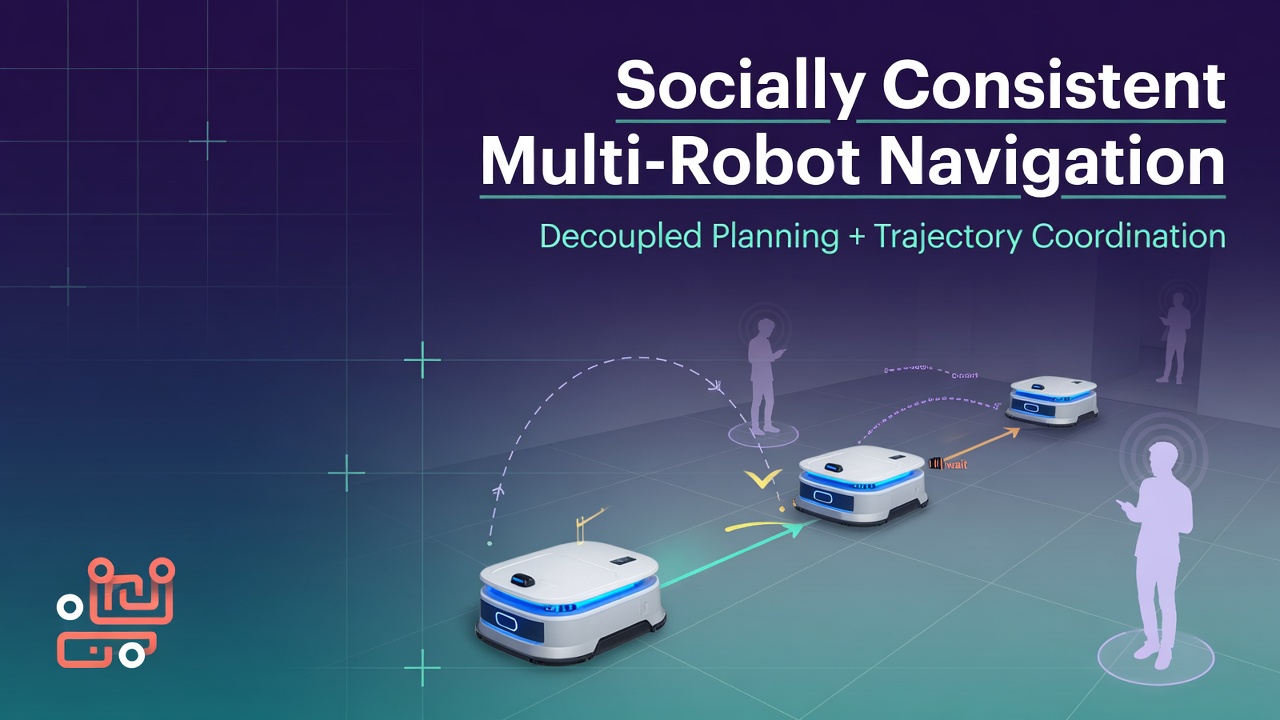
Abstract:The successful integration of mobile robots in human-centric environments requires navigation that is not only safe and efficient, but also predictable and aligned with social conventions, key precursors for human comfort and acceptance. While significant research addresses short-term human-aware planning, these methods often lack mechanisms for ensuring consistent and predictable behaviors across long horizons. Without socially aware long-term planners, local planners are overburdened, resulting in inefficient and locally reactive movements that undermine predictability. This paper introduces a partially decentralized framework that generates predictable and socially consistent multi-robot motion by decoupling global path planning from trajectory coordination. First, we propose a modified A* planner that embeds macroscopic social norms into the planner cost function. Planned paths are shared across mobile robots to collaboratively build a social graph of established routes, which enforces path consistency and reduces future planning effort. Second, we leverage the emergent structure of the socially constrained paths to formulate the multi-robot trajectory coordination problem as a mixed-integer convex program. The convex program enables efficient computation of conflict- free trajectories, scaling effectively to large fleets and supporting dynamic task assignment. Our results demonstrate that enforcing social consistency at the path planning stage produces predictable, socially compliant mobile robot paths and simplifies the otherwise complex problem of multi-robot coordination.
Submission history
From: Matthew Sato [view email]
[v1]
Wed, 22 Jul 2026 22:38:07 UTC (1,411 KB)
0 Comments
Log in to join the conversation.No comments yet. Be the first to share your thoughts.