
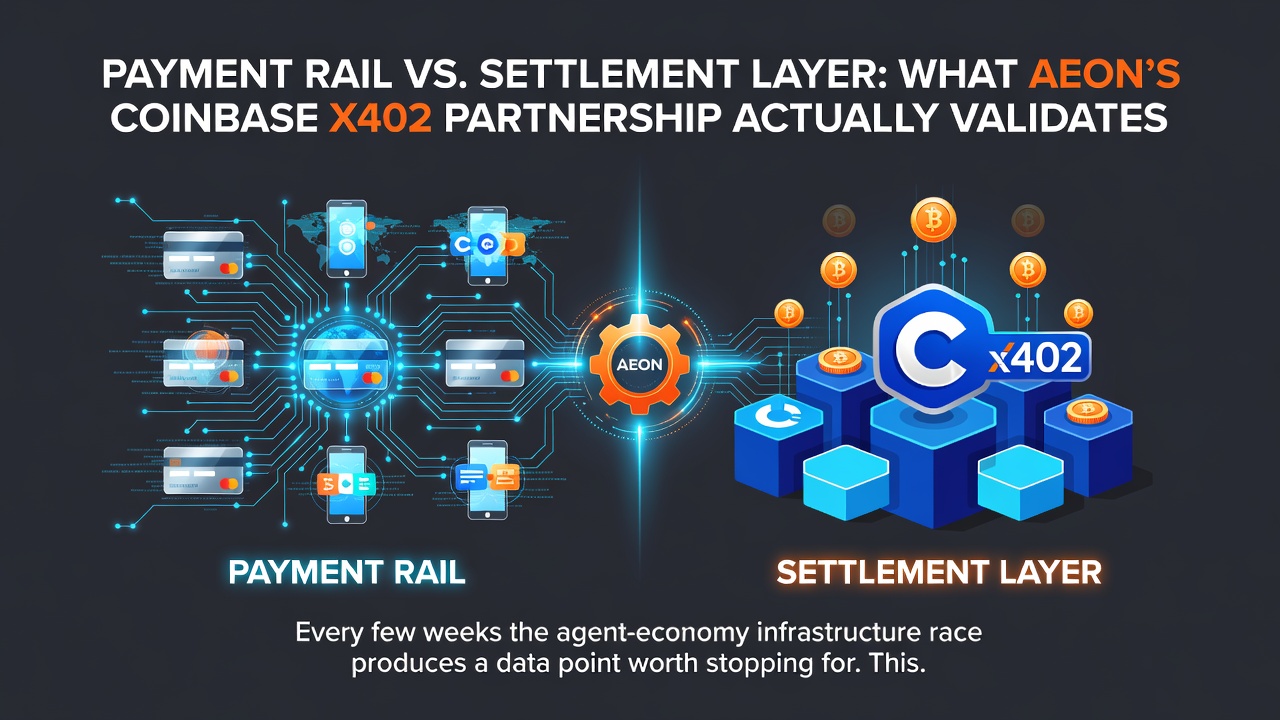
Every few weeks the agent-economy infrastructure race produces a data point worth stopping for. This one: AEON, which raised an $8M pre-seed round led by YZi Labs in May to build a "settlement layer for the agentic economy," became one of Coinbase's early x402 ecosystem partners and says it has shipped an x402 Facilitator and SDK on BNB Chain.
That's a real milestone, and it's worth being precise about what it proves and what it doesn't.
What x402 actually does
x402 repurposes the long-dormant HTTP 402 "Payment Required" status code so an API can demand payment inline, and an AI agent can pay it without a human clicking a button. An agent calls an endpoint, gets a 402, resolves it with a stablecoin micropayment (mostly USDC on Base so far), and the call completes. No API keys to provision, no invoice to reconcile after the fact.
That's a genuinely hard problem for the agent economy, and the volume backs up that it's being solved: on-chain data shows AI agents have executed well over 100 million payments in the past year, the large majority in USDC, with average ticket sizes clustering around $0.30-$0.50. Coinbase and Cloudflare formalizing an x402 Foundation, and a funded player like AEON building distribution across 50M+ merchants on top of it, is the payment-rail layer maturing in real time.
What it doesn't do
A payment rail settles a completed action. Agent calls API, agent pays, merchant receives funds, transaction closed. That flow assumes one side of the exchange (the API response) happens first, and payment follows - the equivalent of "buy now, pay now" for a single, atomic unit of value that either the API delivered or it didn't.
Cross-chain asset trading is a different problem. Two parties each hold an asset the other wants, on two different chains, and neither wants to send first. That's the settlement problem HTLCs (hash time-locked contracts) were built to solve back in 2013, well before "agent economy" was a phrase anyone used: both legs of the trade are locked behind the same cryptographic secret, so either both sides settle or neither does. No bridge holding funds mid-transit. No custodian standing between two parties who don't trust each other.
Payment rails don't need this property, because they're not solving a two-sided, cross-chain exchange problem. That's not a knock on x402 or AEON - it's a different layer, doing a different job, and Coinbase's own docs describe it as a payment protocol, not a settlement primitive for asset swaps.
PayPal made this safe for humans once already
The analogy we keep coming back to: PayPal's actual innovation wasn't moving money, banks already did that. It was making it safe to transact with a stranger you'd never met, by inserting itself as an intermediary both sides could trust.
Hashlock is trying to do the equivalent thing for on-chain trades between strangers, minus the intermediary. We fuse sealed-bid RFQ (so pricing isn't front-run before a trade even starts) with HTLC atomic settlement, and expose the whole flow as six MCP tools: create an RFQ, respond to one, negotiate, fund a leg, claim a leg, check deal status. An AI agent - Claude, GPT, Cursor, any MCP-compatible client - can discover a counterparty, negotiate a price, and settle a cross-chain trade without a human in the loop and without either side's funds sitting in a bridge contract waiting to be drained.
Your money never leaves your wallet until theirs arrives. That's the property a payment rail doesn't need to have, and the property we think cross-chain agent trading can't ship without.
Where the two layers actually meet
We don't think this is a competitive story. If x402-style payment rails and AP2/ACP-style intent layers keep maturing, that's more agents transacting autonomously, which is more demand for a settlement layer underneath the ones that need to swap assets across chains rather than just pay for a completed API call. Google's AP2 and OpenAI/Stripe's ACP are solving the "how does an agent express and authorize intent" problem; x402 is solving "how does an agent pay for a discrete action." Hashlock is solving "how do two parties, possibly both autonomous, exchange assets across chains without trusting each other or a middleman."
Three different layers. All three need to exist for the stack to be complete.
What we shipped
Small but real: hashlock-tech/mcp (scoped) is now at version 0.5.1 on npm. Six MCP tools, atomic settlement live end-to-end on Ethereum mainnet. Sui contracts are deployed and CLI-tested (gateway wiring still in progress - not calling that "live" until it is). Bitcoin settlement is validated on signet via P2WSH HTLC scripts, mainnet pending.
If you want the formal treatment of the sealed-bid RFQ + HTLC design, the writeup is on SSRN: https://papers.ssrn.com/sol3/papers.cfm?abstract_id=6712722
The question worth arguing about
If your agent stack needs to both pay for API calls and trade assets across chains, are you building or buying the settlement primitive underneath the payment rail - and does it actually need to be atomic, or is "probably fine, we'll add insurance later" good enough for what you're building?
Repo: https://github.com/Hashlock-Tech/hashlock-mcp
Try it: https://hashlock.markets?utm_source=devto&utm_medium=blog&utm_campaign=2026-08-02-settlement-layer-race
0 Comments
Log in to join the conversation.No comments yet. Be the first to share your thoughts.