
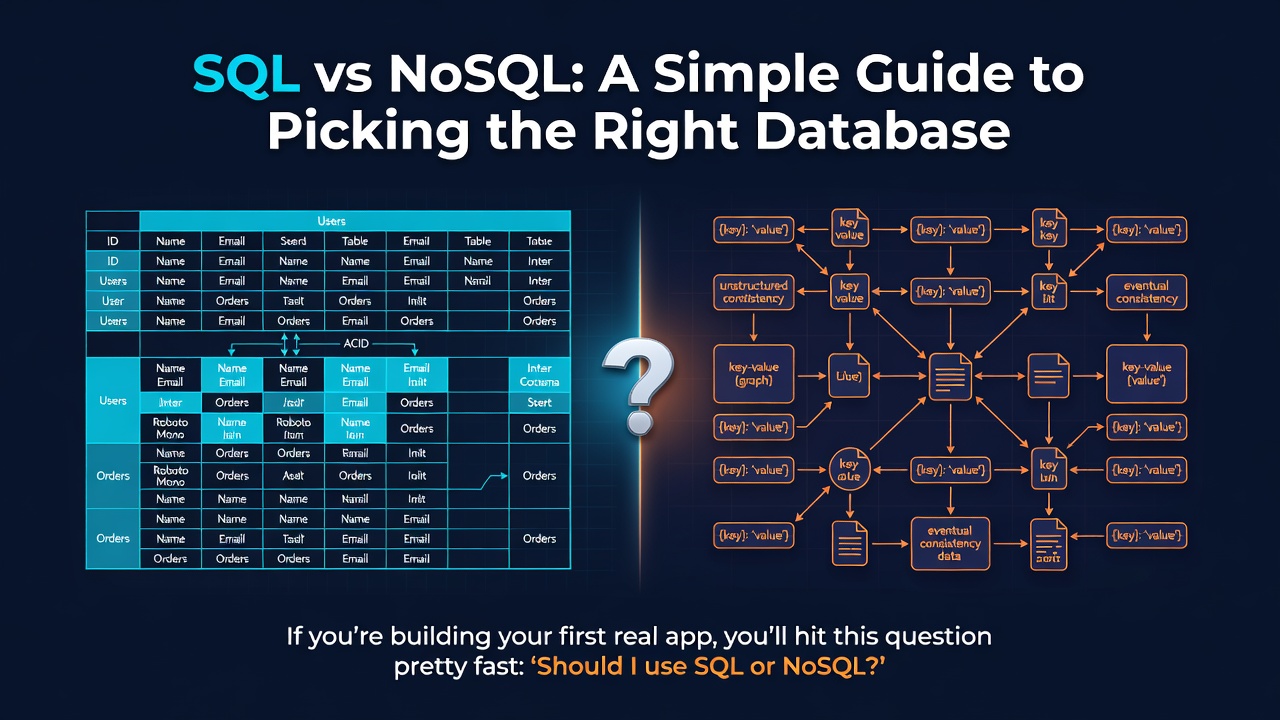
If you're building your first real app, you'll hit this question pretty fast: "Should I use SQL or NoSQL?"
It sounds intimidating, but once you get the core idea, it's actually pretty simple. Let's break it down.
What's a database anyway?
A database is just a place to store your app's data so it doesn't vanish the moment you close the browser. Think of it as a very organized filing cabinet. How you organize that cabinet is where SQL and NoSQL split off.
SQL databases: structured and strict
SQL databases (like PostgreSQL, MySQL, or SQLite) store data in tables — rows and columns, like a spreadsheet. Every row follows the same structure, and tables can be linked to each other.
Example: a simple users and orders setup.
CREATE TABLE users (
  id SERIAL PRIMARY KEY,
  name VARCHAR(100),
  email VARCHAR(100)
);

CREATE TABLE orders (
  id SERIAL PRIMARY KEY,
  user_id INT REFERENCES users(id),
  item VARCHAR(100),
  price DECIMAL
);
Enter fullscreen mode Exit fullscreen mode
Want all orders for a specific user? One clean query:
SELECT orders.item, orders.price
FROM orders
JOIN users ON orders.user_id = users.id
WHERE users.email = '[email protected]';
Enter fullscreen mode Exit fullscreen mode
That JOIN is SQL's superpower. Relationships between data are enforced by the database itself, and querying across them is straightforward.
NoSQL databases: flexible and fast
NoSQL databases (like MongoDB, Firebase, or Redis) don't force your data into rigid tables. The most common type — document databases — store data as JSON-like objects, and each document can look different from the next.
Example: the same "user with orders" idea in MongoDB.
{
  "_id": "0001",
  "name": "Jane",
  "email": "[email protected]",
  "orders": [
    { "item": "Keyboard", "price": 45 },
    { "item": "Mouse", "price": 20 }
  ]
}
Enter fullscreen mode Exit fullscreen mode
Everything about Jane lives in one document. No joins needed — you just fetch it.
The real differences
| SQL | NoSQL | |
|---|---|---|
| Structure | Fixed tables, rows & columns | Flexible documents/objects |
| Schema | Defined upfront | Can change anytime |
| Relationships | Strong, via joins | Usually nested or duplicated |
| Scaling | Mostly vertical (bigger server) | Built for horizontal scaling |
| Good for | Transactions, complex queries | Fast iteration, huge write volume |
So which one should you use?
Honestly, it depends on what you're building.
- Building something involving money, inventory, or anything that needs strict consistency (banking, e-commerce checkout)? Go SQL.
- Building something where the data shape changes often, or that needs to handle a ton of reads/writes fast (chat apps, activity feeds, content platforms)? NoSQL fits better.
Here's the part most tutorials skip: you don't have to pick just one. A lot of real production apps use both — SQL for core transactional data, and something like Redis for caching or MongoDB for logs and analytics. This mix is sometimes called polyglot persistence, and it's more common than people think.
Wrapping up
SQL vs NoSQL isn't really a battle — it's a tradeoff between structure and flexibility. Once you understand what each one is actually good at, the choice usually makes itself based on what you're building.
0 Comments
Log in to join the conversation.No comments yet. Be the first to share your thoughts.