

The xrpld 3.3.0 release is expected next week with five proposed amendments, including two revised features that were previously withdrawn after researchers found bugs that could have allowed unauthorized transactions or fee draining.

- The XRP Ledger’s upcoming xrpld 3.3.0 release will ask validators to approve five amendments, including revised versions of previously flawed Batch and Permission Delegation features.
- Batch would allow up to eight cross-account transactions to execute atomically, while Permission Delegation would let institutions grant narrowly scoped signing authority without exposing full control.
- New amendments—Confidential MPT, Sponsored Fees and Reserves, and Dynamic MPT—aim to enable private tokenized-asset activity, let institutions sponsor users’ XRP costs, and make certain token properties adjustable without full migrations, all still requiring 80% validator approval for two weeks.
The XRP Ledger's next software release will put five new features in front of validators, two of which were pulled from the network after security researchers found flaws serious enough to warrant emergency action.
Jazzi Cooper, head of product at RippleX, said Friday that xrpld 3.3.0 is expected next week carrying Confidential MPT, Batch, Permission Delegation, Sponsored Fees and Reserves, and Dynamic MPT.
XRPL has already proven it can support tokenized assets at scale. Now it’s time to put these assets to use: global transfers, trading, collateralizing, and settling.
The upcoming release of xrpld 3.3.0 includes five amendments that move XRPL significantly closer to that goal.…
— Jazzi Cooper (@jazzicoop) July 31, 2026
Amendments are proposed protocol changes that only take effect once at least 80% of trusted validators back them for two consecutive weeks, a threshold designed so the network rather than Ripple decides what ships.
The Batch and Permission Delegation amendments have been through that process before and failed it.
Batch, which lets up to eight transactions across different accounts execute together so that either all succeed or none do, reached its voting phase in February.
Security researcher Pranamya Keshkamat and the firm Cantina had then found a flaw in how the amendment validated signatures that would have let an attacker execute transactions from any account without holding its keys.
Validators (entities that supply their resources to run and maintain a network) were advised to reject it, and an emergency server release marked it unsupported to prevent activation. No funds were lost, because it never reached the main network.
Permission Delegation, which lets an institution grant another account narrowly scoped authority without handing over full signing power, was disclosed as vulnerable in September 2025 and disabled.
The bug allowed one account to charge transaction fees to another and potentially drain its balance. The ledger's documentation has listed both amendments as obsolete since, to be replaced by revised versions.
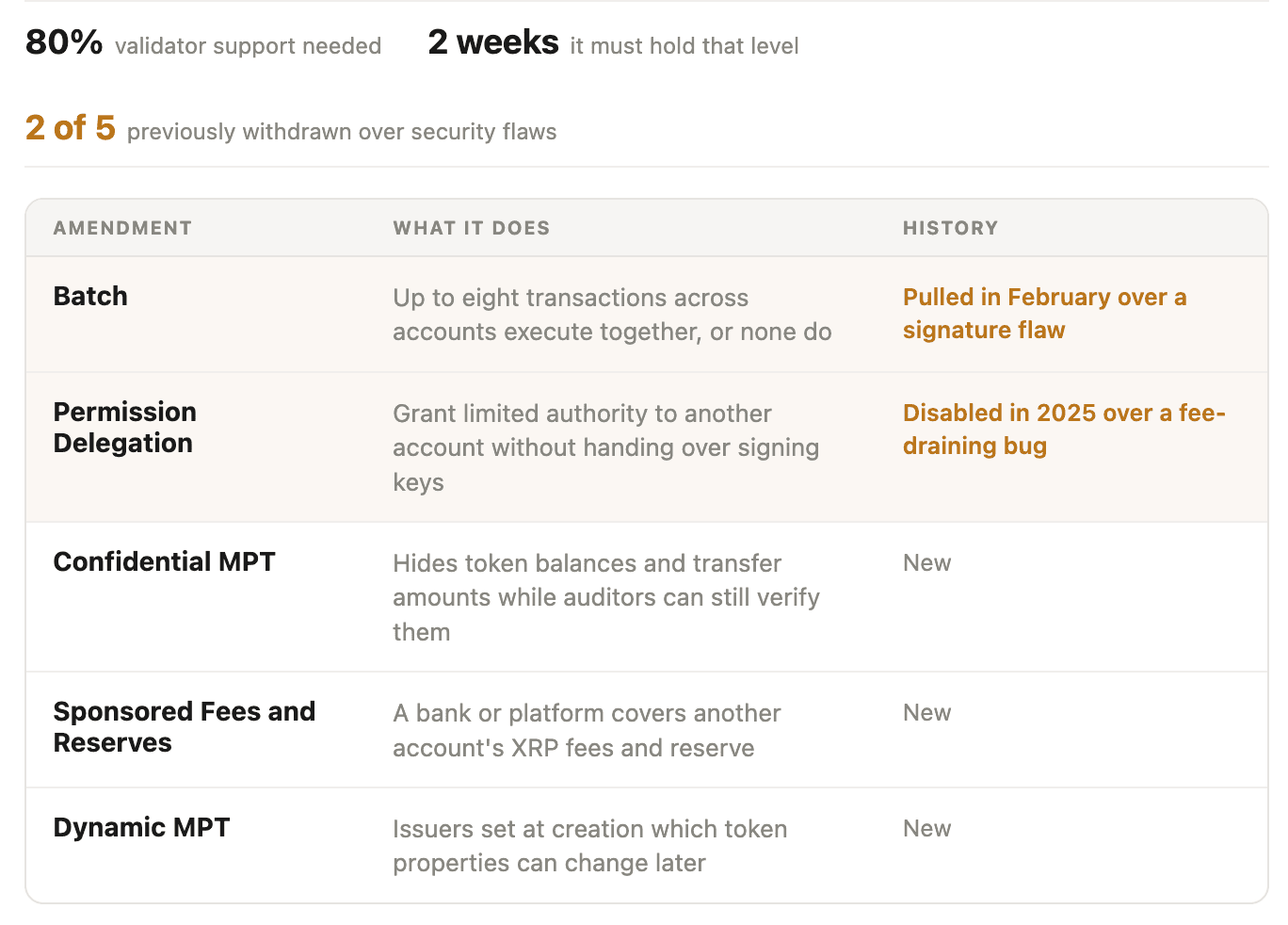
The other three are new. Confidential MPT combines zero-knowledge proofs, which let someone prove a statement is true without revealing the underlying data, with elliptic-curve encryption, so that balances and transfer amounts on Multi-Purpose
Tokens stay private while auditors or regulators can still verify them when required.
Sponsored Fees and Reserves lets a bank or platform cover another account's XRP fees and reserve requirement, removing the need for every user to acquire XRP before transacting.
Lastly, Dynamic MPT lets an issuer specify at creation which token properties can be changed later, avoiding a full migration to a new token when fees or metadata need updating.
The release marks a shift from where the ledger stood two weeks ago. In mid-July, all five sat in development on the XRP Ledger's amendment tracker, and what validators could actually vote on was a set of bug-fix bundles covering the lending protocol, single-asset vaults, the permissioned exchange and multi-purpose tokens.
Approval is not automatic. The lending protocol and single-asset vault amendments have each drawn roughly a third of validator support against the 80% they need, and Batch already has a record of being voted down.
The Evolution of the Crypto CEX Landscape: A Case Study on Binance

The Evolution of the Crypto CEX Landscape: A Case Study on Binance
Binance remains crypto’s leading exchange, expanding from spot and derivatives into RWAs, payments, savings, yield, and broader financial services.
Binance remains crypto’s leading exchange, expanding from spot and derivatives into RWAs, payments, savings, yield, and broader financial services.
Why it matters:
Binance remains crypto’s leading exchange, expanding from spot and derivatives into RWAs, payments, savings, yield, and broader financial services.
0 Comments
Log in to join the conversation.No comments yet. Be the first to share your thoughts.