
[Submitted on 23 Jul 2026]
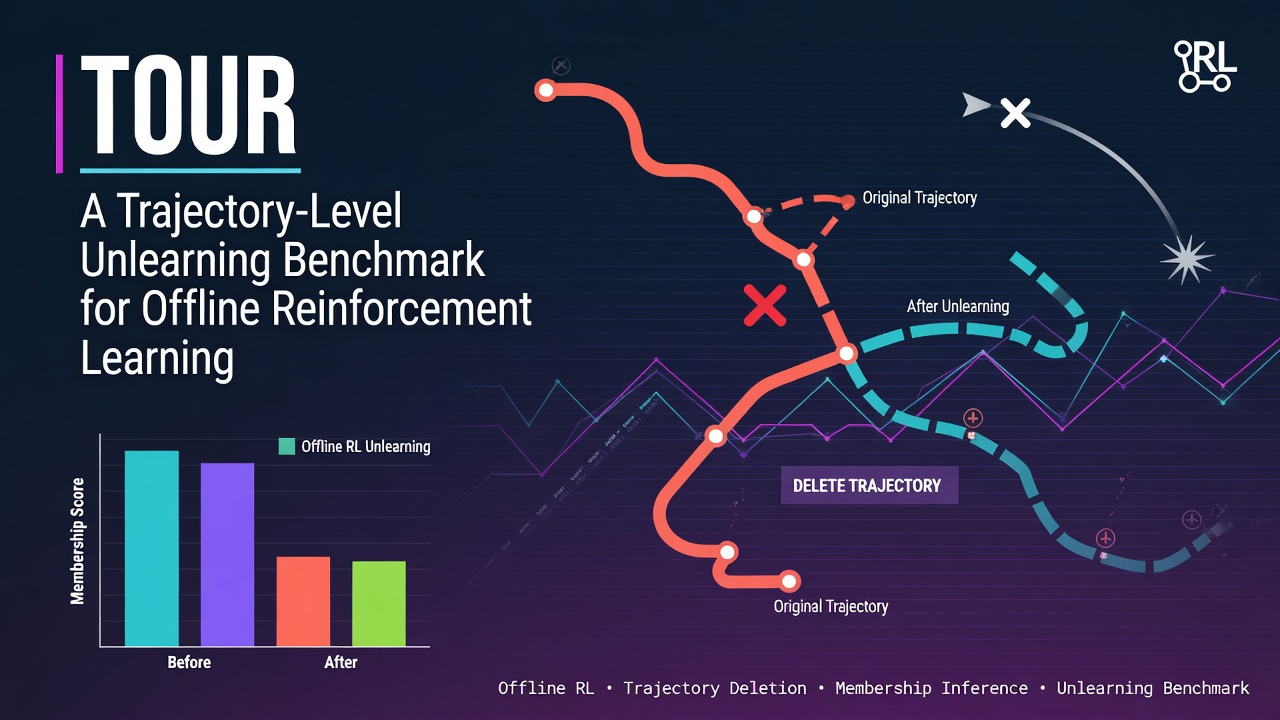
摘要:Offline Reinforcement Learning (RL) agents are trained on fixed behavioral trajectories, which makes trajectory-level deletion important when selected data must be removed after training. Evaluating such deletion is difficult because a lower membership score can reflect trajectory removal, residual memorization visible to another attack, or policy collapse that destroys useful behavior. We introduce Trajectory-level memOrization and Unlearning in offline RL (TOUR), a benchmark that combines trajectory-level partitioning, matched non-member controls, retraining references, retained-performance anchors, and multi-attack privacy auditing. Across D4RL locomotion experiments and an exploratory AntMaze extension, TOUR shows that common deletion baselines have environment-dependent privacy-utility behavior. Retraining and fine-tuning often provide stronger retained-utility references than uniform GA+Refit, while TrajDeleter remains a useful comparator but is not uniformly stronger under the same audit. Reference-model, threshold, deviation, equivalence, action-error, representation-based, and query-limited attacks further show that a single likelihood-based membership score can overstate deletion quality. In the evaluated settings, conclusions about offline RL unlearning are therefore not stable under single-score auditing. They depend on matched non-member construction, retraining-relative calibration, attack family, retained utility, and explicit scope for diagnostic architecture or component-level evidence.
Submission history
From: Chaofan Pan [view email]
[v1]
Thu, 23 Jul 2026 09:40:40 UTC (235 KB)
0 Comments
Log in to join the conversation.No comments yet. Be the first to share your thoughts.